



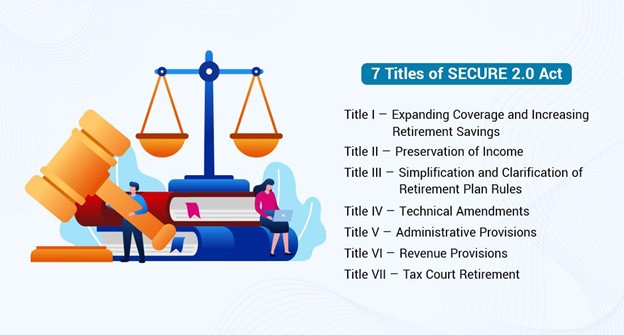
Title I — Expanding Coverage and Increasing Retirement Savings
101 Expanding automatic enrollment in retirement plans
102 Modification of credit for small employer pension plan startup costs
103 Saver’s Match
104 Promotion of Saver’s Match
105 Pooled employer plan modification
106 Multiple employer 403(b) plans
107 Increase in age for the required beginning date for mandatory distributions
108 Indexing IRA catch-up limit
109 Higher catch-up limit to apply at ages 60, 61, 62, and 63
110 Treatment of student loan payments as elective deferrals for purposes of matching contributions
111 Application of credit for small employer pension plan startup costs to employers which join an existing plan
112 Military spouse retirement plan eligibility credit for small employers.
113 Small immediate financial incentives for contributing to a plan
114 Deferral of tax for certain sales of employer stock to employee stock ownership plan sponsored by S corporation
115 Withdrawals for certain emergency expenses
116 Allow additional nonelective contributions to SIMPLE plans
117 Contribution limit for SIMPLE plans
118 Tax treatment of certain nontrade or business SEP contributions
119 Application of section 415 limit for certain employees of rural electric cooperatives
120 Exemption for certain automatic portability transactions
121 Starter 401(k) plans for employers with no retirement plan
122 Assist States in locating owners of applicable savings bonds
123 Certain securities treated as publicly traded in case of employee stock ownership plans
124 Modification of age requirement for qualified ABLE programs
125 Improving coverage for part-time workers
126 Special rules for certain distributions from long-term qualified tuition programs to Roth IRAs
127 Emergency savings accounts linked to individual account plans
128 Enhancement of 403(b) plans
Title II — Preservation of Income
201 Remove required minimum distribution barriers of life annuities
202 Qualifying longevity annuity contracts
203 Insurance-dedicated exchange-traded funds
204 Eliminating a penalty on partial annuitization
Title III — Simplification and Clarification of Retirement Plan Rules
301 Recovery of retirement plan overpayments
302 Reduction in excise tax on certain accumulations in qualified retirement plans
303 Retirement savings lost and found
304 Updating dollar limit for mandatory distributions
305 Expansion of Employee Plans Compliance Resolution System
306 Eliminate the “first day of the month” requirement for governmental section 457(b) plans
307 One-time election for qualified charitable distribution to the split-interest entity; increase in qualified charitable distribution limitation
308 Distribution to firefighters
309 Exclusion of certain disability-related first responder treatment payments
310 Application of top-heavy rules to defined contribution plans covering excludable employees
311 Repayment of qualified birth or adoption distribution limited to 3 years
312 Employer may rely on employee certifying that deemed hardship distribution conditions are met
313 Individual retirement plan statute of limitations for excise tax on excess contributions and certain accumulations
314 Penalty-free withdrawal from retirement plans for an individual case of domestic abuse
315 Reform of family attribution rule
316 Amendments to increase benefit accruals under the plan for the previous plan year allowed until the employer tax return due date
317 Retroactive first-year elective deferrals for sole proprietors
318 Performance benchmarks for asset allocation funds.
319 Review and report to Congress relating to reporting and disclosure requirements
320 Eliminating unnecessary plan requirements related to unenrolled participants
321 Review of pension risk transfer interpretive bulletin
322 Tax treatment of IRA involved in a prohibited transaction
323 Clarification of substantially equal periodic payment rule
324 Treasury guidance on rollovers
325 Roth plan distribution rules
326 Exception to the penalty on early distributions from qualified plans for individuals with a terminal illness
327 Surviving spouse election to be treated as an employee
328 Repeal of direct payment requirement on exclusion from gross income of distributions from governmental plans for health and long-term care insurance
329 Modification of eligible age for exemption from early withdrawal penalty
330 Exemption from early withdrawal penalty for certain State and local government corrections employees.
331 Special rules for the use of retirement funds in connection with qualified federally declared disasters
332 Employers allowed replacing SIMPLE retirement accounts with safe harbor 401(k) plans during a year
333 Elimination of additional tax on corrective distributions of excess contributions
334 Long-term care contracts purchased with retirement plan distributions
335 Corrections of mortality tables
336 Report to Congress on section 402(f) notices
337 Modification of required minimum distribution rules for special needs trust
338 Requirement to provide paper statements in certain cases
339 Recognition of tribal government domestic relations orders
340 Defined contribution plan fee disclosure improvements
341 Consolidation of defined contribution plan notices
342 Information needed for financial options risk mitigation act
343 Defined benefit annual funding notices
344 Report on pooled employer plans
345 Annual audits for a group of plans
346 Worker Ownership, Readiness, and Knowledge (WORK) Act.
347 Report by the Secretary of Labor on the impact of inflation on retirement savings
348 Cash balance
349 Termination of variable rate premium indexing
350 Safe harbor for corrections of employee elective deferral failures
Title IV — Technical Amendments
401 Amendments relating to Setting Every Community Up for Retirement Enhancement Act of 2019
Title V — Administrative Provisions
501 Provisions relating to plan amendments
Title VI — Revenue Provisions
601 SIMPLE and SEP Roth IRAs
602 Hardship withdrawal rules for 403(b) plans
603 Elective deferrals are generally limited to the regular contribution limit
604 Optional treatment of employer matching or nonelective contributions as Roth contributions
605 Charitable conservation easements
606 Enhancing retiree health benefits in pension plans
Title VII — Tax Court Retirement
701 Provisions relating to judges of the Tax Court
702 Provisions relating to special trial judges of the Tax Court
When Will the Act Come into Effect?
Ed Slott, CPA, IRA expert, and president of Ed Slott & Co, warns tax advisors that, while some provisions came into effect starting on January 1, 2023, others won’t go into effect until 2024, 2025, or even later.
He predicts that the piling on of exceptions, all with different types of rules and limits, may complicate matters for individuals and require tax professionals to get ahead of this change.
Within 401(k) plans, pipes will need to be created to “get the messaging [out] to participants,” says Jennifer Doss. Doss is the senior director and defined contribution (D.C.) practice leader at Captrust Financial Advisors, who notes:
“Particularly from a retirement plan, recordkeeper perspective, they have to figure out how to make all this work. … It will take a year or two to build and get all the technology up and running.”
How to Prepare for SECURE 2.0
Join us on February 15th & 16th, 2023 as Michael Miranda, CPA, QKA, AEP, a Senior Manager with Williams & Company CPA PC takes a deep dive into “The Secure Act 2.0 Review.”

Michael has a wealth of experience as a tax specialist. Before joining Williams & Company in 1989, he was on staff as a Tax Specialist with Price Waterhouse, providing tax and estate planning for individuals and small to medium-sized businesses. He currently holds CPA licenses in Iowa, Minnesota, and South Dakota.
Date: Wednesday, February 15, 2023 and Thursday, February 16, 2023
Time: 2:00 pm – 3:00 pm
Field of study: Federal Tax Update
Level: Intermediate
Pricing:
Register link: The SECURE Act 2.0 Review Webinar
We look forward to seeing you there