Issue 5: Education Issues - For tax years 2021-2025, discharges of many public and private student loans are excluded from gross income.
- If certain requirements are met, an individual who redeems Series EE bonds issued after 1989 or Series I bonds may exclude all or part of the interest income on those bonds that would otherwise be taxable, to the extent used to pay the cost of attending college, vocational school, or other post-secondary educational institution (for the individual, a spouse, or a dependent). The exclusion phases out above a specified income threshold.
- For clients planning to buy bonds as a year-end gift, consider feasibility of gifting cash to the parent of the child to enable the parent to buy the bonds in the parent's name. That way, if the bonds are redeemed to pay for the child's education, the exclusion may be available depending on the parents' income situation at redemption time.
- A 529 plan, also known as a qualified tuition plan, is a tax-advantaged savings plan designed to encourage saving for education costs. 529 plans are sponsored by states, state agencies, or educational institutions and contributions to such plans are considered completed gifts for federal gift tax purposes.
- 529 plans enable participants to prepay tuition costs for a particular beneficiary or contribute to an education savings account established to pay a beneficiary’s elementary and secondary tuition and higher education expenses, certain apprenticeship programs, and up to $10,000 of student loan debt.
- Clients may also contribute up to $2,000 annually to a tax-exempt Coverdell Education Savings Account (Coverdell ESA) for an individual under age 18 (and special needs beneficiaries of any age). The maximum contribution is reduced ratably for modified AGI between $190,000 and $220,000 for joint filers, and between $95,000 and $110,000 for others
Issue 6: Earned Income Tax Credit - For 2022, the maximum earned income credit is $6,935 for those with three or more qualifying children.
- The amount of earned income on which the earned income tax credit will be computed is $7,320 for clients with no qualifying children, $10,980 for clients with one qualifying child, and $15,410 for clients with two or more qualifying children.
- For 2022, the phaseout of the allowable earned income tax credit will begin at $15,290 for joint filers with no qualifying children ($9,160 for others with no qualifying children), and at $26,260 for joint filers with one or more qualifying children ($20,130 for others with one or more qualifying children).
- The amount of disqualified income (generally investment income) a client may have before losing the entire earned income tax credit is $10,300 for 2022.
- The under-65 maximum age limit for claiming the credit, for those who do not have a qualifying child, is reinstated for 2022.
Issue 7: Retirement Issues - The required minimum distribution (RMD) rules apply in 2022. Under current law, individuals who turned 72 in 2022 must take their first distribution by April 1, 2023.
- Older plan participants must take their RMDs by the end of 2022.
- Individuals are not required to take RMDs from Roth IRAs.
- Converting a traditional IRA to a Roth IRA will increase modified AGI, and potentially expose income (or more income) to the 3.8% NIIT. If possible, time year-end conversions to keep MAGI below the applicable NIIT threshold. If other net investment income will be lower next year, consider delaying the conversion.
- For NIIT purposes, investment income does not include distributions from tax-favored retirement plans, such as qualified employer plans and IRAs. However, taxable distributions from these plans, including RMDs, are included in MAGI, potentially exposing other investment income to the extra tax. Clients nearing the MAGI threshold, or who already exceed it because of other income, may have an RMD planning opportunity.
- The first RMD can be taken without penalty as late as April 1 of the year following the year the participant reaches age 72 (or, if older, retires). The additional distribution may cause the client to be in a higher tax bracket or become subject to the 3.8% NIIT. However, when making the two RMDs in separate years causes both years to be adversely affected, rather than just one, consider delaying the first distribution into the second year if that doesn’t result in it being taxed at a higher rate.
- 401(k) limit increases to $22,500 for 2023, IRA limit rises to $6,500.
Issue 8: Gifting and Estate Tax - The annual gift tax exclusion, now $16,000, will increase to $17,000 in 2023.
- A gift that qualifies for the exclusion is not subject to gift tax or Generation-Skipping Transfer Tax. Unused annual exclusions cannot be carried over and are forever lost. It is best to make exclusion-eligible gifts as early as possible so as not to lose any of their benefit.
Issue 9: Business Issues - Congress passed the Inflation Reduction Act of 2022 which extends, through 2024, the credit for electricity produced from certain renewable resources; the energy credit; and other energy related credits (with various extension dates).
- The Act also introduces two new corporate taxes and various new clean energy related tax credits. But these will not go into effect until 2023. The two corporate taxes are: (a) the 15% corporate alternative minimum tax on the adjusted financial statement income of applicable corporations (sometimes referred to as the “Book Minimum Tax”) and (b) the 1% excise tax on the repurchase of corporate stock.
- Through 2022, a 100% first-year deduction for the adjusted basis of depreciable property is allowed for qualified property acquired and placed in service during the year. Qualifying property includes tangible property depreciated under MACRS with a recovery period of 20 years or less, most computer software, qualified film, television, and live theatrical productions, and water utility property. Possible higher tax rates next year might make some businesses want to defer placing bonus-depreciation-eligible property into service until next year, or to opt out of bonus depreciation on their tax return for this year.
- The 100% bonus depreciation stays in effect until January 1, 2023.
At that point, the first-year bonus depreciation deduction decreases as follows: - 80% for property placed in service during 2023.
- 60% for property placed in service during 2024.
- 40% for property placed in service during 2025.
- 20% for property placed in service during 2026.
For 2022, the maximum amount of § 179 property that can be expensed is $1,080,000. That full amount is available until qualifying property placed in service during the year reaches $2,700,000, at which point a phase out begins. Issue 10: Net Operating Losses - Changes to the NOL deduction in 2021 as well as other recent-year changes impact year-end planning opportunities and strategies. Some recent changes to the NOL deduction and carryback rules are worth noting:
- 2018, 2019, and 2020 NOLs may be carried back five years and carried forward indefinitely.
- Post-2020 NOLs may not be carried back (except for farm losses, which may be carried back two years), but may be carried forward indefinitely.
- Starting with the 2021 tax year, the NOL deduction is subject to an 80% of taxable income limitation (not counting the NOL or the qualified business income deduction) NOLs from before 2018 could be carried back two years and carried forward only 20 years.
- Starting with the 2021 tax year, deductions for NOLs generated after 2017 are limited by the 80% standard, but unused losses may be carried forward indefinitely.
- NOL carryforwards of noncorporate taxpayers are increased by their nondeductible “excess business losses,” which are, with many modifications, the excess of the taxpayer's aggregate trade or business deductions for the tax year over its aggregate gross business income or gain plus $250,000 ($500,000 for joint return filers), as adjusted for inflation.
Issue 11: Extenders or Expiring Provisions Provisions that expired at the end of 2021 (and have not been extended into 2022 as of time of publication): - Mortgage insurance premium deduction.
- Health coverage tax credit.
- CARES Act charitable deduction for nonitemizers (with modifications).
- The increased income limit for charitable deductions for itemizers.
- Computation of adjusted taxable income without regard to any deduction allowable for depreciation, amortization, or depletion (business interest deduction limitations).
- Three-year depreciation for racehorses two years or younger.
- Accelerated depreciation for business property on an Indian reservation.
- American Samoa Economic Development Credit.
- Indian Employment Tax Credit.
- Mine Rescue Team Training Credit.
- 12.5% increase in annual Low Income Housing Tax Credit (LIHTC) authority.
- Payroll tax credits for COVID-19 sick and family leave.
- Employee Retention Credit.
- Prevention of partial plan termination.
Provisions extended through December 31, 2024, via the Inflation Reduction Act of 2022: - Credit for electricity produced from certain renewable resources.
- Energy credit.
- Other energy-related credits (with various extension dates).
Provisions recently extended through December 31, 2025: - CARES Act exclusion for employer payments of student loans.
- Exclusion for canceled mortgage debt.
- New Markets Tax Credit.
- Work Opportunity Credit.
- Empowerment Zone Tax Incentives.
- Employer Credit for paid family and medical leave.
Provisions recently made permanent: - 7.5% floor for the medical expense deduction.
- Exclusion of benefits for volunteer firefighters and emergency medical responders.
- Credit for certain expenditures for maintaining railroad tracks.
Rev. Proc. 2022-38 – 2023 Inflation Adjustments – Select Issues Issue 12: Adoption Credit For taxable years beginning in 2023, under § 23(a)(3) the credit allowed for an adoption of a child with special needs is $15,950. For taxable years beginning in 2023, under § 23(b)(1) the maximum credit allowed for other adoptions is the amount of qualified adoption expenses up to $15,950. The available adoption credit begins to phase out under § 23(b)(2)(A) for taxpayers with modified adjusted gross income in excess of $239,230 and is completely phased out for taxpayers with modified adjusted gross income of $279,230 or more. Issue 13: Child Tax Credit For taxable years beginning in 2023, the amount used in § 24(d)(1)(A) to determine the amount of credit under § 24 that may be refundable is $1,600. Issue 14: Earned Income Credit For taxable years beginning in 2023, the following amounts are used to determine the earned income credit under § 32(b). The “earned income amount” is the amount of earned income at or above which the maximum amount of the earned income credit is allowed. The “threshold phaseout amount” is the amount of adjusted gross income (or, if greater, earned income) above which the maximum amount of the credit begins to phase out. The “completed phaseout amount” is the amount of adjusted gross income (or, if greater, earned income) at or above which no credit is allowed. The threshold phaseout amounts and the completed phaseout amounts shown in the table below for married taxpayers filing a joint return include the increase provided in § 32(b)(2)(B), as adjusted for inflation for taxable years beginning in 2023. The threshold phaseout amounts and the completed phaseout amounts shown in the table below for single, surviving spouse, or head of household taxpayers also apply to married taxpayers who are not filing a joint return and satisfy the special rules for separated spouses in § 32(d). Issue 15: Excessive Investment Income For taxable years beginning in 2023, the earned income tax credit is not allowed under § 32(i) if the aggregate amount of certain investment income exceeds $11,000. Issue16: Refundable Credit for Coverage Under a Qualified Health Plan For taxable years beginning in 2023, the limitation on tax imposed under § 36B(f)(2)(B) for excess advance credit payments is determined using the following table: Issue 17: Employee Health Insurance Expense of Small Employers For taxable years beginning in 2023, the dollar amount in effect under § 45R(d)(3)(B) is $30,700. This amount is used under § 45R(c) for limiting the small employer health insurance credit and under § 45R(d)(1)(B) for determining who is an eligible small employer for purposes of the credit. Issue 18: Exemption Amounts for Alternative Minimum Tax For taxable years beginning in 2023, the exemption amounts under § 55(d)(1) are; For taxable years beginning in 2023, under § 55(b)(1), the excess taxable income above which the 28 percent tax rate applies is: For taxable years beginning in 2023, the amounts used under § 55(d)(2) to determine the phaseout of the exemption amounts are: Issue 19: Alternative Minimum Tax Exemption for a Child Subject to the “Kiddie Tax” For taxable years beginning in 2023, for a child to whom the § 1(g) “kiddie tax” applies, the exemption amount under §§ 55(d) and 59(j) for purposes of the alternative minimum tax under § 55 may not exceed the sum of (1) the child's earned income for the taxable year, plus (2) $8,800.
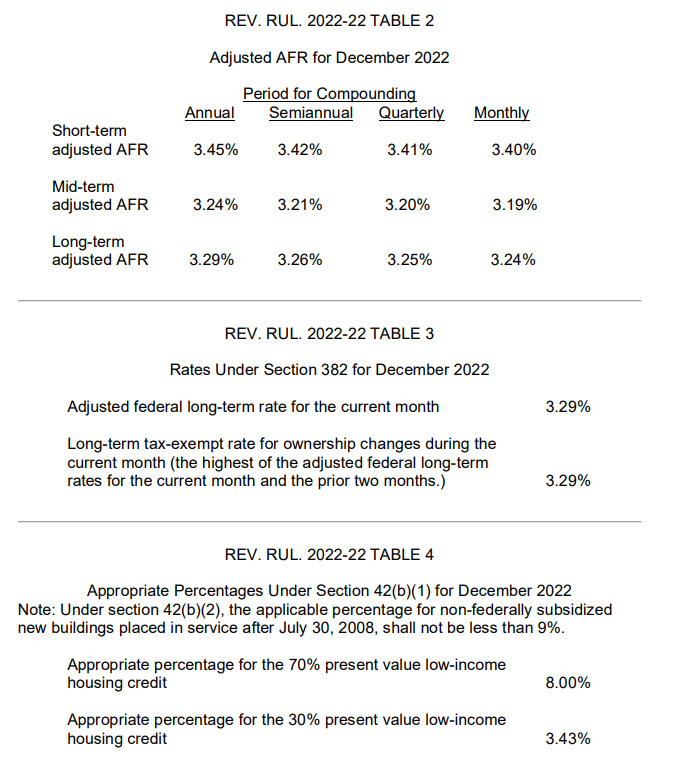
Issue 20: Certain Expenses of Elementary and Secondary School Teachers. For taxable years beginning in 2023, under § 62(a)(2)(D) the amount of the deduction allowed under § 162 that consists of expenses paid or incurred by an eligible educator in connection with books, supplies (other than nonathletic supplies for courses of instruction in health or physical education), computer equipment (including related software and services) and other equipment, and supplementary materials used by the eligible educator in the classroom is $300. Issue 21: Standard Deduction (1) In general. For taxable years beginning in 2023, the standard deduction amounts under § 63(c)(2) are as follows: Dependent. For taxable years beginning in 2023, the standard deduction amount under § 63(c)(5) for an individual who may be claimed as a dependent by another taxpayer cannot exceed the greater of (1) $1,250, or (2) the sum of $400 and the individual's earned income. Aged or blind. For taxable years beginning in 2023, the additional standard deduction amount under § 63(f) for the aged or the blind is $1,500. The additional standard deduction amount is increased to $1,850 if the individual is also unmarried and not a surviving spouse. Issue 22: Cafeteria Plans For taxable years beginning in 2023, the dollar limitation under § 125(i) on voluntary employee salary reductions for contributions to health flexible spending arrangements is $3,050. If the cafeteria plan permits the carryover of unused amounts, the maximum carryover amount is $610. Issue 23: Qualified Transportation Fringe Benefit For taxable years beginning in 2023, the monthly limitation under § 132(f)(2)(A) regarding the aggregate fringe benefit exclusion amount for transportation in a commuter highway vehicle and any transit pass is $300. The monthly limitation under § 132(f)(2)(B) regarding the fringe benefit exclusion amount for qualified parking is $300. Issue 24: Income from United States Savings Bonds for Clients Who Pay Qualified Higher Education Expenses For taxable years beginning in 2023, the exclusion under § 135, regarding income from United States savings bonds for taxpayers who pay qualified higher education expenses, begins to phase out for modified adjusted gross income above $137,800 for joint returns and $91,850 for all other returns. The exclusion is completely phased out for modified adjusted gross income of $167,800 or more for joint returns and $106,850 or more for all other returns. Issue 25: Adoption Assistance Programs For taxable years beginning in 2023, under § 137(a)(2), the amount that can be excluded from an employee's gross income for the adoption of a child with special needs is $15,950. For taxable years beginning in 2023, under § 137(b)(1) the maximum amount that can be excluded from an employee's gross income for the amounts paid or expenses incurred by an employer for qualified adoption expenses furnished pursuant to an adoption assistance program for adoptions by the employee is $15,950. The amount excludable from an employee's gross income begins to phase out under § 137(b)(2)(A) for clients with modified adjusted gross income in excess of $239,230 and is completely phased out for clients with modified adjusted gross income of $279,230 or more. Issue 26: Gross Income Limitation for a Qualifying Relative For taxable years beginning in 2023, the exemption amount referenced in § 152(d)(1)(B) is $4,700. Issue 27: Election to Expense Certain Depreciable Assets For taxable years beginning in 2023, under § 179(b)(1), the aggregate cost of any § 179 property that a taxpayer elects to treat as an expense cannot exceed $1,160,000 and under § 179(b)(5)(A), the cost of any sport utility vehicle that may be taken into account under § 179 cannot exceed $28,900. Under § 179(b)(2), the $1,160,000 limitation under § 179(b)(1) is reduced (but not below zero) by the amount by which the cost of § 179 property placed in service during the 2023 taxable year exceeds $2,890,000. Issue 28: Energy Efficient Commercial Building Deduction For taxable years beginning in 2023, the applicable dollar value used to determine the maximum allowance of the deduction under § 179D(b)(2) is $0.54 increased (but not above $1.07) by $0.02 for each percentage point by which the total annual energy and power costs for the building are certified to be reduced by a percentage greater than 25 percent. For taxable years beginning in 2023, the applicable dollar value used to determine the increased deduction amount for certain property under § 179D(b)(3) is $2.68 increased (but not above $5.36) by $0.11 for each percentage point by which the total annual energy and power costs for the building are certified to be reduced by a percentage greater than 25 percent. Issue 29: Qualified Business Income For taxable years beginning in 2023, the threshold amounts under § 199A(e)(2) and phase-in range amounts under § 199A(b)(3)(B) and § 199A(d)(3)(A) are: Issue 30: Eligible Long-Term Care Premiums For taxable years beginning in 2023, the limitations under § 213(d)(10), regarding eligible long-term care premiums includible in the term “medical care,” are as follows: Issue 31: Medical Savings Account (1) Self-only coverage. For taxable years beginning in 2023, the term “high deductible health plan” as defined in § 220(c)(2)(A) means, for self-only coverage, a health plan that has an annual deductible that is not less than $2,650 and not more than $3,950, and under which the annual out-of-pocket expenses required to be paid (other than for premiums) for covered benefits do not exceed $5,300. (2) Family coverage. For taxable years beginning in 2023, the term “high deductible health plan” means, for family coverage, a health plan that has an annual deductible that is not less than $5,300 and not more than $7,900, and under which the annual out-of-pocket expenses required to be paid (other than for premiums) for covered benefits do not exceed $9,650. Issue 32: Interest on Education Loans For taxable years beginning in 2023, the $2,500 maximum deduction for interest paid on qualified education loans under § 221 begins to phase out under § 221(b)(2)(B) for taxpayers with modified adjusted gross income in excess of $75,000 ($155,000 for joint returns) and is completely phased out for taxpayers with modified adjusted gross income of $90,000 or more ($185,000 or more for joint returns). Issue 33: Limitation on Use of Cash Method of Accounting For taxable years beginning in 2023, a corporation or partnership meets the gross receipts test of § 448(c) for any taxable year if the average annual gross receipts of such entity for the 3-taxable-year period ending with the taxable year which precedes such taxable year does not exceed $29,000,000. Issue 34: Threshold for Excess Business Loss For taxable years beginning in 2023, in determining a client’s excess business loss, the amount under § 461(l)(3)(A)(ii)(II) is $289,000 ($578,000 for joint returns). Issue 35: Tax Responsibilities of Expatriation For taxable years beginning in 2023, the amount that would be includible in the gross income of a covered expatriate by reason of § 877A(a)(1) is reduced (but not below zero) by $821,000 pursuant to § 877A(a)(3). Issue 36: Foreign Earned Income Exclusion For taxable years beginning in 2023, the foreign earned income exclusion amount under § 911(b)(2)(D)(i) is $120,000. Issue 37: Notice of Large Gifts Received from Foreign Persons For taxable years beginning in 2023, § 6039F authorizes the Secretary of the Treasury or her delegate to require recipients of gifts from certain foreign persons to report these gifts if the aggregate value of gifts received in the taxable year exceeds $18,567. Issue 38: Persons Against Whom a Federal Tax Lien Is Not Valid For calendar year 2023, a federal tax lien is not valid against (1) certain purchasers under § 6323(b)(4) who purchased personal property in a casual sale for less than $1,810, or (2) a mechanic's lien or under § 6323(b)(7) who repaired or improved certain residential property if the contract price with the owner is not more than $9,030. Issue 39: Property Exempt from Levy For calendar year 2023, the value of property exempt from levy under § 6334(a)(2) (fuel, provisions, furniture, and other household personal effects, as well as arms for personal use, livestock, and poultry) cannot exceed $10,810. The value of property exempt from levy under § 6334(a)(3) (books and tools necessary for the trade, business, or profession of the taxpayer) cannot exceed $5,400. Issue 40: Exempt Amount of Wages, Salary, or Other Income For taxable years beginning in 2023, the dollar amount used to calculate the amount determined under § 6334(d)(4)(B) is $4,700. Issue 41: Failure to File Tax Return In the case of any return required to be filed in 2024, the amount of the addition to tax under § 6651(a) for failure to file an income tax return within 60 days of the due date of such return (determined with regard to any extensions of time for filing) will not be less than the lesser of $485 or 100 percent of the amount required to be shown as tax on such return. Issue 42: Failure to File Partnership Return In the case of any return required to be filed in 2024, the dollar amount used to determine the amount of the penalty under § 6698(b)(1) is $235. Issue 43: Failure to File S Corporation Return In the case of any return required to be filed in 2024, the dollar amount used to determine the amount of the penalty under § 6699(b)(1) is $235. Issue 44: Revocation or Denial of Passport in Case of Certain Tax Delinquencies For calendar year 2023, the amount of a serious delinquent tax debt under § 7345 is $59,000. Issue 45: Qualified Small Employer Health Reimbursement Arrangement For taxable years beginning in 2023, to qualify as a qualified small employer health reimbursement arrangement under § 9831(d), the arrangement must provide that the total amount of payments and reimbursements for any year cannot exceed $5,850 ($11,800 for family coverage). Other News Issue 46: Reminder: Service Providers, Others May Receive 1099-Ks for Sales Over $600 in Early 2023 - IR-2022-189 The Internal Revenue Service reminds taxpayers earning income from selling goods and/or providing services that they may receive Form 1099-K, Payment Card and Third-Party Network Transactions, for payment card transactions and third-party payment network transactions of more than $600 for the year. There is no change to the taxability of income; the only change is to the reporting rules for Form 1099-K. As before, income, including from part-time work, side jobs or the sale of goods, is still taxable. Clients must report all income on their tax return unless it is excluded by law, whether they receive a Form 1099-NEC, Nonemployee Compensation; Form 1099-K; or any other information return. The IRS emphasizes that money received through third-party payment applications from friends and relatives as personal gifts or reimbursements for personal expenses is not taxable. The American Rescue Plan Act of 2021 (ARPA) lowered the reporting threshold for third-party networks that process payments for those doing business. Prior to 2022, Form 1099-K was issued for third party payment network transactions only if the total number of transactions exceeded 200 for the year and the aggregate amount of these transactions exceeded $20,000. Now a single transaction exceeding $600 can trigger a 1099-K. Issue 47: Employers Warned to Beware of Third Parties Promoting Improper Employee Retention Credit Claims The Internal Revenue Service today warned employers to be wary of third parties who are advising them to claim the Employee Retention Credit (ERC) when they may not qualify. Some third parties are taking improper positions related to client eligibility for and computation of the credit. These third parties often charge large upfront fees or a fee that is contingent on the amount of the refund and may not inform clients that wage deductions claimed on the business' federal income tax return must be reduced by the amount of the credit. If the business filed an income tax return deducting qualified wages before it filed an employment tax return claiming the credit, the business should file an amended income tax return to correct any overstated wage deduction. Issue 48: IRS Prepares for 2023 Filing Season With 4,000 New Assistors - IR 2022-191The IRS on October 27 announced that it has hired 4,000 new customer service representatives, also known as phone assistors, to help answer phone calls and to provide other customer services. The IRS hopes to add another 1,000 customer service reps by the end of the year. According to the news release the IRS used its new funding and direct hire authority to speed up the hiring process and brought on the new employees in just over two months. The IRS announcement states that many of these employees, having finished their training and will be in place for the start of the 2023 tax season. With these new employees, the IRS anticipates that phones will be answered at a much higher level than during the 2022 filing season. In addition to phone assistors, the IRS is also working to hire additional people throughout the agency, including in information technology and compliance positions. These positions will be posted on USAjobs.gov. Issue 49: IRS Veteran O’Donnell Is Named Agency’s Acting CommissionerPresident Joe Biden intends to nominate Danny Werfel - a former budget official and private sector leader - to become the next IRS commissioner. If approved by the Senate, Werfel will oversee plans for the IRS overhaul, along with a backlog of millions of returns. Until the time Congress approves the nomination, Douglas O'Donnell has been designated acting commissioner of the IRS and will succeed Commissioner Chuck Rettig when Rettig's term ends on November 12, 2022. O'Donnell has been with the IRS for 36 years, serving in various roles including his current post as deputy commissioner for services and enforcement. He will lead the agency on an interim basis until a successor nominated by President Joe Biden's administration is confirmed by the Senate. As acting commissioner, O'Donnell will oversee plans for spending the $80 billion in additional funding the IRS received through the Inflation Reduction Act (PL 117-169), which Biden signed in August. The newly named acting commissioner of the IRS, along with two former holders of the position, outlined the agency’s immediate goals following the authorization of $80 billion in additional funding, as well as guiding principles it should maintain moving forward. To help facilitate what O'Donnell described as broad "transformation efforts," a new central office within the IRS has been established. According to the new interim commissioner, this office will coordinate the implementation of the inflation bill's myriad provisions with various divisions, information technology staff, and the Human Capital Office. Such cross-departmental collaboration has already been instrumental in the beginning months since the legislation's enactment. According to O'Donnell, the IRS aims to have prepared a strategic operating plan, as required by Treasury Secretary Janet Yellen. O'Donnell said that right now, hiring is a major priority, especially ahead of the upcoming tax filing season. New hires will consist of IT experts, data scientists, and compliance enforcement agents. According to O'Donnell, the IRS currently employees 38,000 fewer workers than in 1992 when the population of the U.S. was 30% smaller. He noted that the modern tax code is substantially more complex, especially surrounding cross-border activity. Alongside bringing on new staff, a simultaneous goal should also be to retain the existing workforce, he continued, as the agency has an annual attrition rate of 8,000 people, largely due to retirement. Issue 50: Form 941 Mission Critical Backlog DecreasesForm 941 processing backlog. Regarding the critical work, as of October 20, 2022, the IRS notes there are 2.9 million unprocessed Forms 941. In mid-August 2022, there were 4.8 million unprocessed forms. The October 20, 2022, backlog is nearly half of that total. Part of August's higher numbers may have to do with the filing of second quarter 2022 Form 941s, which were due by July 31, 2022. This may mean another spike in unprocessed returns next month since the third quarter 2022 returns are due by October 31, 2022. The IRS advises that if an employer filed a Form 941 electronically and received an acknowledgement, no further action is required other than promptly responding to any requests for information. The IRS notes that tax returns are processed in the order they are received. Backlog for corrected Forms 941 too. There also remains a large backlog of Forms 941-X (Adjusted Employer's Quarterly Federal Tax Return or Claim for Refund). As of October 19, 2022, the IRS's total inventory of unprocessed Forms 941-X was approximately 230,000. This number is actually an increase from the IRS's August 17, 2022, total of only 135,000. The IRS explains that some Forms 941-X cannot be processed until the related Forms 941 are processed, which may account for increased processing delays. The IRS add that although not all of the backlogged returns involve a COVID-19 tax credit, the inventory is being worked on at two sites (Cincinnati and Ogden) with trained staff to work possible any related credit. Issue 51: IRS Revises Gross Tax Gap Estimate to $496 Billion – IR-2022-192The IRS has published the latest gross tax gap estimates for tax years 2014 through 2016, which showed an increase of $58 billion over previous figures to reach $496 billion. As described by the agency, the gross tax gap is the difference between estimated 'true' tax liability for a given period and the amount of tax that is paid on time. After late payments and actions by the IRS, an additional $68 billion was collected, producing a net tax gap of $428 billion. The IRS noted that between the two periods, 2011-2013 and 2014-2016, the estimated tax liability grew by more than 23%. According to the IRS, the new gross tax gap comprises three components: - Non filing (tax not paid on time by those who do not file in a timely manner, $39 billion).
- Underreporting (tax understated on timely filed returns, $398 billion) and
- Underpayment (tax that was reported on time, but not paid on time, $59 billion).
Based on the projections for 2017-2019, the estimated average gross tax gap is projected to be $540 billion per year. Gross tax gap component projections were provided for tax years 2017-2019, including underreporting ($41 billion), underreporting ($433 billion), and underpayment ($66 billion). Issue 52: Automated Collection Notices to Phase Back In, Taxpayer Advocate SaysTemporarily suspended mailings of automated collection notices will resume on a staggered basis to spare IRS customer service representatives and tax practitioners from a deluge of taxpayer correspondence, though it is unclear when this process will - or should - begin. The IRS "has a plan" for how it will restart the mailing of collection notices that were temporarily suspended, which is to "spread it over a period of time." The applicable individual and business notices and their Spanish language counterparts pertain to outstanding balances, unfiled returns and return delinquencies, intents to levy, and withholding compliance. They were paused to allow the IRS time to process the backlog of original and amended returns without causing confusion for taxpayers and their representatives. Issue 53: New 1099 Filing Portal Slated to Launch January 9 During the November 3 IRS payroll industry call, the IRS revealed further details on the on the 1099 filing portal that is due to launch in 2023. Background. § 2102 of the Taxpayer First Act (TFA) requires the IRS to develop an internet platform by January 1, 2023, that will allow taxpayers to electronically file Forms 1099. The new platform will allow users to prepare, file, provide Forms 1099 suitable for distribution, and create and maintain tax records. The launch date for the new 1099 filing platform, the Information Return Intake System (IRIS), will be January 9, 2023. Users will be able to file Forms 1099 through IRIS by keying information or uploading a.csv file using a downloadable template as provided by the IRS. IRIS will allow users to download and print 1099s suitable for distribution and allow users to file 1099s with the IRS and state tax agencies that participate in the Combined Federal/State Filing Program. While the.csv template is limited to 100 entries, users may upload an unlimited number of.csv templates. IRIS TCC Code required Users with an existing FIRE Transmitter Control Code (TCC) will not be able to use that TCC for the IRIS. An IRIS TCC is required to use the new portal. Transmitters can begin applying for IRIS TCC by December 5, 2022. While it may take up to 45 days for processing, the IRS noted it will most likely only take a few days. As previously announced IRIS, unlike the FIRE system, will use xml schemas. However, the Application to Application (A2A) will not launch when the IRIS portal becomes available on January 9. Therefore, bulk filers must continue to use FIRE during the 2023 filing season. For Forms 1099-NEC due January 31, bulk filers must use FIRE, while low volume filers may use the new IRIS portal. The IRS also noted that, in the future, IRIS will be expanded to permit creation and the filing of Affordable Care Act (ACA) information statements. No timeline was provided for the expansion. Issue 54: IRS-CI Releases FY2022 Annual Report Highlighting More than 2,550 Investigations, 90% Conviction Rate; Enforcement Actions Focused on Tax Fraud, Money Laundering, Cybercrimes – IR-2022-194 In fiscal year 2022, IRS Criminal Investigation initiated more than 2,550 criminal investigations, identified over $31 billion from tax and financial crimes, and obtained a 90.6% conviction rate on cases accepted for prosecution. In FY22, IRS-CI expanded partnerships with foreign counterparts to help combat tax and financial crimes on a global level. IRS-CI special agents delivered trainings in countries like Argentina, Germany, Colombia, and Palau on topics ranging from cybercrime to human trafficking. IRS-CI Mexico City, after changes to Mexico law that enabled the extradition of tax fugitives, launched an initiative to identify fugitives who had absconded to Mexico and nearby countries. IRS-CI joined Taskforce Kleptocapture in March 2022 to target Russian oligarchs and other sanctions-evaders. As of September 2022, the agency had identified nearly 50 individuals and entities for potential sanctions-related enforcement. IRS-CI’s 2,077 special agents spent about 70% of their time investigating tax-related crimes like tax evasion and tax fraud during FY22, while nearly 30% of their time was spent on money laundering and drug trafficking cases. Special agents identified over $31 billion from tax and financial crimes, and the agency seized assets valued at approximately $7 billion in FY22. IRS-CI is the only U.S. federal law enforcement agency that focuses 100% on financial investigations. Case examples include:The IRS-CI Cyber Crime Unit, with assistance from U.S. authorities, traced billions of dollars of Bitcoin stolen from Bitfinex, a cryptocurrency exchange, after a 2016 hack. This led to the February 2022 arrest of Ilya Lichtenstein and his wife, Heather Morgan, for alleged conspiracy to launder stolen cryptocurrency. IRS-CI special agents lawfully seized and recovered more than 94,000 stolen Bitcoin, which was valued at over $3.6 billion at the time, marking the largest seizure in U.S. history. The Tampa Field Office investigated Michael Dexter Little for tax-related crimes. He was sentenced to 19 years and six months in federal prison in January 2022 for conspiracy to commit wire fraud, conspiracy to commit money laundering and aggravated identity theft. Little also had to forfeit at least $12.3 million, traceable to his offenses. He filed a series of false tax returns, claiming massive, bogus fuel tax credits. He filed the false returns in his own name and the names of co-conspirators, as well as identity theft victims. He obtained at least $12.3 million in fraudulent tax refunds and attempted to obtain at least $27 million more. Little and his co-conspirators used scheme proceeds to purchase real estate and other assets for themselves. The Oakland Field Office investigated Jeff and Paulette Carpoff for running a billion-dollar fraud scheme centered around DC Solar. Investors were duped into investing in DC Solar based on fake financial and engineering reports, and the money was used to fund the Carpoff’ lavish lifestyle, which included a NASCAR sponsorship, ownership of a minor league baseball team, luxury real estate and more. The federal government seized and auctioned off 148 of the Carpoff’ vehicles to recoup more than $8 million for scheme victims. In November 2021, Jeff Carpoff was sentenced to 30 years in prison, and in June, Paulette Carpoff was sentenced to 11 years in prison. The report also includes additional case examples for each U.S. field office, an overview of IRS-CI’s international footprint, details about the specialized services provided by IRS-CI and investigative statistics, broken down by discipline, for FY22. IRS-CI is the criminal investigative arm of the IRS, responsible for conducting financial crime investigations, including tax fraud, narcotics trafficking, money-laundering, public corruption, healthcare fraud, identity theft and more. IRS-CI special agents are the only federal law enforcement agents with investigative jurisdiction over violations of the Internal Revenue Code, boasting a near 90% federal conviction rate. The agency has 20 field offices located across the U.S. and 12 attaché posts abroad. Issue 55: Applicable Federal Rates for December 2022, Rev. Rul. 2022-22 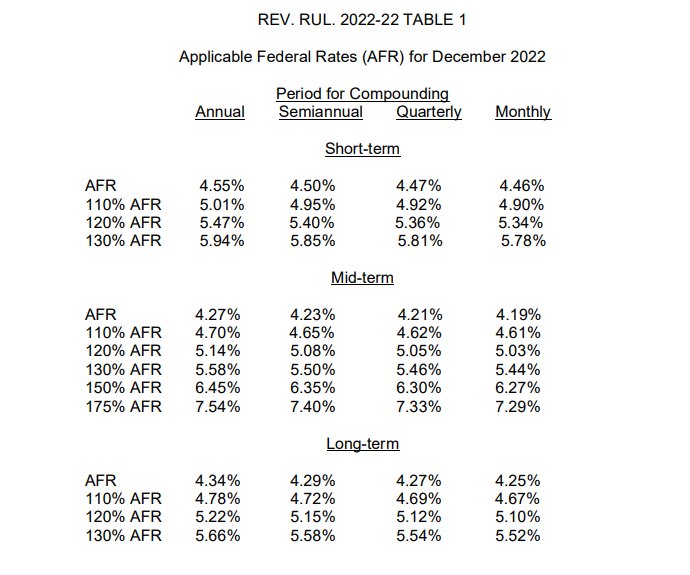
|
