Section 01
Edition notes and highlights
Guidance has slowed down considerably over the last few weeks. We are still expecting additional guidance on QBI and its effect on cooperatives, and IRS announced future proposed regulations to clarify certain aspects of the centralized partnership audit regime.
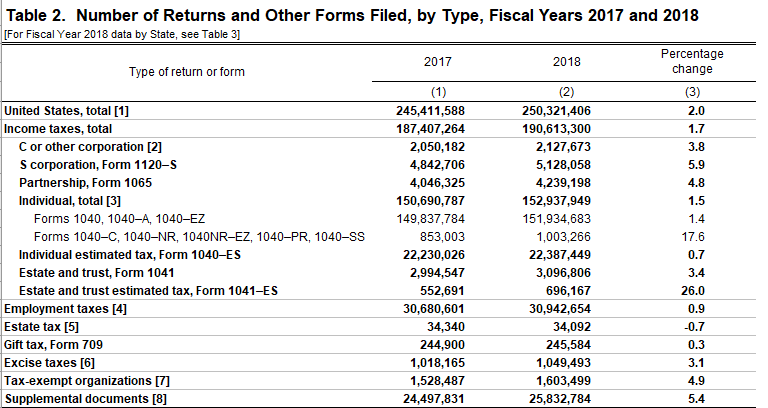
The IRS released the Data Book for 2018 showing range of tax data including audits, collection actions and taxpayer service. During fiscal year 2018, the IRS collected nearly $3.5 trillion, processed more than 250 million tax returns and other forms, and issued over 120 million individual income tax refunds totaling almost $395 billion.
The IRS received and processed more of every major type of form during FY 2018 than during the prior year, with the exception of estate tax returns; those filings were down slightly less than 1 % compared to the prior year. However, filings of pass-through entities were up in FY 2018; partnerships filed almost 5 % more forms with the IRS in FY 2018 than in the prior year, S-corporation filings were up almost 6 % in the same timeframe.
The IRS provided taxpayer assistance through more than half-billion visits to IRS.gov and helped more than 64.8 million taxpayers through different service channels, such as correspondence, toll-free telephone helplines or at Taxpayer Assistance Centers. There were also more than 309 million inquiries to the “Where’s My Refund?” application, up 11 % compared to the prior year.
Net revenue from delinquent collection activities rose to just over $40 billion, an increase of 1.6 % compared to the prior year. IRS levies were up 8.3 % compared to the prior year, but the agency filed about 8 % fewer liens than in fiscal year 2017.
Compared to the prior year, there were fewer audits during fiscal year 2018. The IRS audited more than 892,000 individual income tax returns during the fiscal year, down slightly from the prior year.
This Fall, we will be discussing the issues listed below at our seminars:
2019 Tax Legislation–Overview: Let us provide you with an overview of new law enacted in 2019 and IRS rulings and pronouncements. We will cover some key issues where guidance has been issued concerning prior enacted law, additional guidance on the SALT deduction, meals and entertainment and other updates as released.
Safe Harbor Election & Rentals: To Use or Not to Use, that is the Question? Notice 2019-07 – released concurrently with the Final Regs, provides notice of a proposed revenue procedure detailing a proposed safe harbor under which an RPE enterprise may be treated as a trade or business solely for purposes of IRC §199A. This is a key issue we are monitoring. Additional direction is expected on this issue and as this develops, this session will explain and provide examples that demonstrate the updated guidance. We will discuss related issues on deducting losses from Real Estate.
Centralized Partnership Audit Regime: This section will focus on the new series of forms issued concerning the Centralized Partnership Audit Regime. Form 8988 Election for Alternative to Payment of the Imputed Underpayment – IRC Section 6226, Form 8989, Request to Revoke the Election for Alternative to Payment of the Imputed Underpayment, Form 8980 Partnership Request for Modification of Imputed Underpayments Under IRC Section 6225(c) and more.
754 Election: Review the basics of a §754 Election to “step-up” the basis of the assets within a partnership when one of two events occur: distribution of partnership property or transfer of an interest by a partner. Basic class but will discuss how QBI is impacted.
Ethics and the Tax Client: During the past several years, news rules have been adopted or proposed that impact how we interact with our clients. This segment will provide a look at the latest IRS regulations and changes to professional standards. Security is all important and one segment of our discussion will center on the issue of protecting your client’s data. We will discuss how to ethically interact with the QBI deduction when you address the issue with your client. And finally, a review of the disciplinary proceedings you could face if your practice comes under scrutiny from the Office of Professional Responsibility.
IRS Procedures: We’ll present information on how to keep your EFIN current, navigating e-services and renewal of IP PTINs. Did you know IRS can “lock” you EFIN in the middle of filing season making you unable to e-file. It’s important to keep that information current, addresses, key officials, etc. E-services is the electronic way of doing business with the IRS. Get answers sooner, get transcripts when needed. What estimates have been paid? With a filed Power of Attorney, you can use e-services to get the above information and save a call to IRS and save time. Other online applications will also be reviewed as well as some common IRS procedures we all need to know.
Insolvency & Cancellation of Debt: A taxpayer is insolvent when the total liabilities exceed his or her total assets. The forgiven debt may be excluded as income under the “insolvency” exclusion. We will review the tax consequences for real estate property that is disposed of through foreclosure, short sale, deed in lieu of foreclosure, and abandonments. We will also delve into which business entity is more, or less, beneficial when it comes to cancellation of debt and insolvency. The segment will include examples and any law updates as the extension of the forgiveness of primary residents’ cancellation of debt (expired in 2017) is still being discuss as a potential retroactive law provision.
Penalty Abatement: We will demonstrate how to navigate a first-time Abatement Program, using Form 843, Rev Procedure 84-35 (Partnership Returns), Written & Oral Advice from the IRS, advice from a tax professional or attorney, ordinary business care, lost or destroyed records, code, regulations, Internal Revenue Manual, and case law to support your reasonable cause position.
Statute of Limitations: A review of the statute of limitations as they apply to federal tax law. If you do not understand your statute limits, a client’s refund could slip through your fingers. Or you could execute an Offer in Compromise for a year where the collection statute expires. With all the new changes a review of this area of the law will be a good refresher for all.
Marijuana & CBD Oil: The US Court of Appeals for the 9th Circuit in Hemp Industries Assn. et.al., vs. U.S. Drug Enforcement Admin., maintained the Drug Enforcement Administration’s (DEA) wide-ranging rule creating a separate classification for “Marijuana Extracts.” Though still illegal in the U.S., Marijuana legalization continues to pick up steam for legalization, due to many states who have adopted laws legalizing the use in various aspects from recreational to medicinal purposes. A review of where we stand taxwise concerning the Marijuana client will be provided.
Can’t attend in person, join the live webinar to earn CPE and get the updates:
Fall Update Webinar: Cedar Rapids October 1
Year-End Webinar: Cedar Rapids December 10
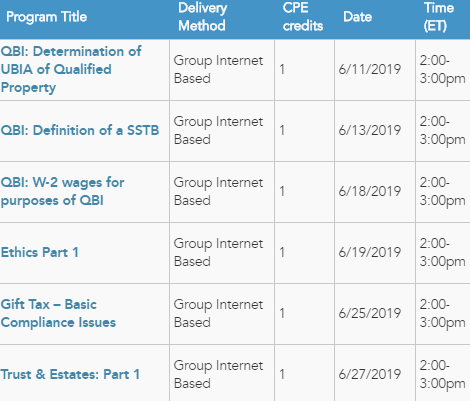
June 2019 Issues