Basics & Beyond Monthly Update
Tax Newsletter
May 2026 | Volume 9, Issue 5
May Highlights
Our second webinar after tax season, May 6, 2026, will delve into typical notices your clients may receive following the filing season conclusion. Discussion will center on when and how to respond.
Each year IRS sends out groups of notices concerning identity theft, balance due notices, offsets to pay past due taxes and refund adjustments. Each notice has requirements as to when and if to respond. Understanding the purpose and the IRS systems are important in keeping your client updated concerning the status of their tax return.
Navigation Tips:
Click on the Issue # link to jump directly to that section. Click any Basics logo to return to the Issues List. The 📌 icon marks an embedded resource link.
Looking ahead to 2026
If you would like to plan your learning calendar, explore upcoming live webinars and self-paced on-demand options.
In this Month’s Issue
- Issue 1 – IRS launches online tool for resolving tax debt
- Issue 2 – Treasury/IRS finalize tip-eligible occupations under OBBB
- Issue 3 – 4 million children enrolled in Trump Accounts
- Issue 4 – Tax return verification updates
- Issue 5 – Form 4070 eliminated; 2025 tip reporting changes
- Issue 6 – IRS provides fix for direct deposit refund issues
- Issue 7 – Age 26 rule for dependent health coverage clarified
- Issue 8 – IRS expands Business Tax Account to partnerships and tax-exempt entities
- Issue 9 – 2026 FUTA/SUTA and unemployment tax compliance updates
- Issue 10 – IRS proposes rules on wagering losses and reporting thresholds
- Issue 11 – Treasury: 53M filers claimed new tax cuts
- Issue 12 – Guidance on handling client refunds and IRS payments
- Issue 13 – Draft revisions to 2026 Form 1099-NEC
- Issue 14 – Applicable Federal Rates for May 2026 (Rev. Rul. 2026-09)

Issue 1 – IRS Launches New Online Tool to Help Taxpayers Resolve Tax Debt
The Internal Revenue Service announced a new online tool to help taxpayers understand and resolve tax debt.
The
Tax Debt Help 📌 tool provides individuals and businesses with a simple, accessible way to explore payment options and identify next steps based on their situation. The tool is part of the IRS’s broader effort to expand digital services and make it easier for taxpayers to meet their obligations.
The Tax Debt Help tool walks users through a series of straightforward questions about their financial situation and tax debt. Based on taxpayer responses, the tool will guide them to potential payment and resolution options available through the IRS.
These options may include payment plans, temporary delay of collection, or an offer in compromise for those who qualify. By presenting options in a clear, structured format, the tool helps taxpayers make informed decisions about how to resolve their tax debt.
Designed for simplicity and privacy The tool is designed to be easy to use and accessible to a wide range of taxpayers. It does not require specialized knowledge and can be used at any time.
To protect taxpayer privacy, the tool does not require taxpayers to enter personally identifiable information. Taxpayers can explore available options without providing details such as Social Security numbers, names, or addresses.

Issue 2 – Treasury, IRS Issue Final Regulations Listing Occupations Where Workers Customarily and Regularly Receive Tips Under the One, Big, Beautiful Bill
Treasury and the Internal Revenue Service have issued
final regulations 📌 on the “No Tax on Tips” provision. The One, Big, Beautiful Bill final regulations provide the list of occupations that receive tips and define “qualified tips” that eligible taxpayers may claim as a deduction. Treasury and the IRS received over 300 comments, and a public hearing was held on Oct. 23, 2025. The final regulations describe the comments and how they are addressed in the final regulations.
The final regulations list more than 70 separate occupations of tipped workers, from bartenders to water taxi operators. Additionally, the final regulations provide clarification on the definition of qualified tips, as well as guidance on other requirements under the section of the tax law defining qualified tips.
List of occupations that receive tips: The List of Occupations that Receive Tips is classified by the Treasury Tipped Occupation Code system, comprising a three-digit code and description for each of the occupations listed within the final regulations. As in the proposed regulations, the final regulations group the occupations into eight categories:
- 100s – Beverage and Food Service
- 200s – Entertainment and Events
- 300s – Hospitality and Guest Services
- 400s – Home Services
- 500s – Personal Services
- 600s – Personal Appearance and Wellness
- 700s – Recreation and Instruction
- 800s – Transportation and Delivery
The final regulations expand the list to include visual artists and floral designers in the personal services category and add gas pump attendants in the transportation and delivery category.
Definition of qualified tips: A worker may only claim the deduction for qualified tips. To be a qualified tip, the tip must be received by a worker in an occupation on the List of Occupations that Receive Tips. The final regulations follow the proposed regulations in further clarifying that qualified tips must satisfy certain requirements:
- Qualified tips must be paid in cash or an equivalent medium, such as check, credit card, debit card, gift card, tangible or intangible tokens that are readily exchangeable for a fixed amount in cash, or another form of electronic settlement or mobile payment application denominated in cash.
- Qualified tips must be received from customers or, in the case of an employee, through a mandatory or voluntary tip-sharing arrangement, such as a tip pool.
- Qualified tips must be paid voluntarily by the customer and not be subject to negotiation. Qualified tips do not include service charges unless the customer has an option to disregard or modify the service charge. For instance, in the case of a restaurant that imposes an automatic 18% service charge for large parties and distributes that amount to waiters, bussers and kitchen staff, if the charge is added with no option for the customer to disregard or modify it, the amounts distributed to the workers from this service charge are not qualified tips.
Importantly, workers can take the deduction only for qualified tips that are included on Form W-2, Form 1099-NEC, Form 1099-MISC, Form 1099-K, or reported by the worker on Form 4137. Gig workers and other self-employed individuals can qualify for this deduction if their occupation is on the List of Occupations that Receive Tips and the other statutory and regulatory requirements are met.
The new law limits the deduction for self-employed individuals to the individual’s net income.

Issue 3 – Filers Signed up 4 million Children for Trump Accounts
Taxpayers have signed up more than 4 million children for
tax-favored Trump Accounts 📌. More than 1 million of those children are covered by elections for the $1,000 Trump Accounts pilot program contribution. Eligibility for the $1,000 pilot program contribution depends on when the child was born.
Tax professionals can remind their qualifying clients about Trump Accounts. Use IRS
Form 4547, Trump Account Election(s) 📌, to request establishment of a Trump Account and to enroll in the pilot program.
Filing Form 4547, Trump Account Elections(s), or completing the online election is only the first step in the Trump Accounts process.
After submission, clients must wait for Treasury’s activation instructions, complete authentication, monitor for the $1,000 pilot program contribution if elected and prepare to make their own personal contributions. Treasury recently announced that BNY will manage the initial accounts while Robinhood will serve as the brokerage and initial trustee. A dedicated Trump Accounts app is also being developed for account access and management.
Upcoming Treasury notifications
Clients may start asking, “I filed to open the account and receive the starter funds, what happens next?” It is important to clarify that submitting the election does not immediately open or fund the account. Instead, the filing reserves the election, and clients must wait for activation instructions from the Treasury, which are expected to begin in May 2026. Until then, clients should retain their Forms 4547 and any correspondence and watch for official notices.
$1,000 pilot program contribution: activation and deposit timeline
For those who elected the $1,000 pilot program contribution, the deposit will not occur immediately. Treasury will contribute only after the account is activated and eligibility is confirmed, and not before July 4, 2026.
Making personal contributions to the Trump Account
Families may also be wondering when they can start making their own contributions to a Trump Account. The good news is that once the account is activated, families, friends, employers, nonprofit organizations and local governments can contribute up to $5,000 per eligible child per year.
- The account must first be opened through Treasury’s authentication process.
- No contributions may be deposited before July 4, 2026.
That gives clients a clear runway: watch for and complete the activation instructions and then be ready to begin funding the account under the program’s contribution limits.
What to expect after filing Form 4547
In summary, filing Form 4547 is just the beginning. Clients must complete activation, and those eligible for the $1,000 contribution may need to wait until after July 4, 2026, for funding. With BNY, Robinhood and a Treasury-controlled app involved, tax professionals can now give clients a clear picture of what to expect next.
- Watch for Treasury activation instructions, expected to begin in May 2026.
- Complete the authentication process to fully open the account.
- Do not expect or make any deposits, including the $1,000 pilot contribution, before July 4, 2026.
- If the $1,000 pilot contribution was elected, wait for Treasury to confirm the account is open and eligibility is met.
- Be ready to make personal contributions once the account is activated.
- Remember that families, friends, employers, nonprofit organizations and local governments can contribute up to $5,000 per year per eligible child.
- Keep a copy of all Forms 4547 and any IRS or Treasury correspondence.
- Monitor official updates at IRS.gov/Form4547 📌 and trumpaccounts.gov 📌.
- Expect account access and management tools to roll out through the new app Treasury is developing with BNY and Robinhood.
- Parents or legal guardians, be prepared to manage the account as the party responsible once it is active.

Issue 4 – Verifying Tax Returns
Sometimes the IRS will send a notice (such as a
CP5447 📌 series notice or a
CP5071 📌 series notice) to a taxpayer to verify that a Form 1040 series tax return was truly filed by the taxpayer. After verifying the legitimacy of such a letter, tax professionals should encourage their clients to follow the steps on the tax return.
If the taxpayer didn’t file the tax return, they could be a victim of identity theft. After the taxpayer responds, the IRS will help the taxpayer take steps to protect their identity.
If the taxpayer filed the tax return, they should verify so the IRS can continue processing the return.
Ways to verify
The simplest way is for taxpayers to verify their identity and tax return online. Taxpayers can sign into their IRS online account (or create an account if they don’t have one) and then answer a few questions to verify the tax return.
If the taxpayer is not able to verify online, they can call the IRS phone number on the notice.
In some cases, a taxpayer may need to visit a local IRS Taxpayer Assistance Center to verify their identity in person.
Returns filed in previous years
If a taxpayer does not verify their identity with the IRS, the IRS won’t process the tax return in question. This can impact the processing for tax returns filed in future years, too. But not to worry: if a taxpayer takes the necessary steps to authenticate their identity, the IRS will continue processing the tax return, even if it was filed in the previous year. Once the IRS determines that the return in question was filed by the taxpayer, the IRS will honor the original received date of the return and issue any refund due.

Issue 5 – Form 4070 is Gone: Why 2025 Tip Reporting Just Got Harder – Thanks to NATP for the Heads Up
Form 4070 is no longer available on the IRS website. For years, it lived inside Publication 1244, Employee’s Daily Record of Tips and Report to Employer. That publication is now obsolete, and with it, the familiar Form 4070.
At first glance, this may not seem like a major change. In practice, it creates a real compliance gap for the 2025 filing season and beyond.
Form 4070 was never filed with the IRS. Employees used it to report tips to their employer, generally by the 10th of the following month, as required under Internal Revenue Code rules. Employers then used those reported amounts for withholding and payroll reporting.
Now that the form is gone, the legal requirement has not changed. Employees must still report tips. Employers must still account for them. What has changed is the standard recordkeeping tool. That creates uncertainty. Without a uniform IRS form, taxpayers and preparers must rely on “similar statements or records” to meet the same requirement.
This change comes at the same time new deductions for qualified tips are taking effect for tax years 2025 through 2028. While the headlines suggest a simple benefit, the reporting system has not caught up. The IRS has confirmed that 2025 Forms W-2 and other information returns were not redesigned to separately show qualified tips. That means practitioners will not always see a clean number on year-end forms.
Instead, they may need to reconstruct tip income using multiple sources:
- Form W-2, Box 7 (allocated tips, if applicable).
- Employer records or statements.
- Employee tip logs or spreadsheets (replacing Form 4070).
- Additional unreported tips reported on Form 4137, Social Security and Medicare Tax on Unreported Tip Income.
Without Form 4070, one of the most reliable contemporaneous records is gone. That increases the burden on taxpayers to maintain consistent documentation.
What replaces Form 4070
The IRS does not require a specific format. Employees can use any record that captures:
- Total tips received
- Dates tips were earned
- Amounts reported to the employer
In practice, this could be a spreadsheet, a notebook or payroll app records. The key is consistency and accuracy. For preparers, this means asking better questions. If a client works in a tipped occupation, do not assume the W-2 tells the full story.
Where Form 4137 still fits
If an employee does not report all tips to the employer, they must still report those amounts on Form 4137. This has not changed. Form 4137 ensures Social Security and Medicare taxes are paid on unreported tips. It also feeds into total income, which may affect any tip-related deduction.
This is where missing Form 4070 records can create problems. If there is no clear monthly reporting trail, it becomes harder to distinguish between reported and unreported tips.
The employer side, §3121(q) 📌
The underlying payroll framework is still intact. Under §3121(q), employers are responsible for their share of Social Security and Medicare tax on tips that employees report to them.
However, if employees do not report tips, the employer is generally not liable for the employer share until the IRS issues a notice and demand. This reinforces why tip reporting still matters, even without Form 4070. The system depends on timely, accurate reporting from employees to employers.
For 2025 returns, the biggest risk is incomplete or inconsistent records. Practitioners should advise clients early to keep detailed tip logs, even without an official IRS form.
Ask clients to bring:
- Pay stubs and employer summaries.
- Personal tip records (monthly or daily).
- Any written reports submitted to employers.
- Documentation supporting unreported tips.
The goal is to build a defensible number when the forms do not provide one.
Form 4070 may be gone, but the rules it supported are still very much in place. Tip reporting did not go away. It simply lost its standard form.

Issue 6 – Client Update: IRS Offers Fix for Direct Deposit Refund Issues
The IRS has provided instructions for taxpayers whose refunds are delayed due to missing or invalid bank information. (
IR 2026-43, 4/2/2026 📌)
How to Resolve Direct Deposit Refund Issues
The IRS has encouraged all taxpayers expecting a refund to provide banking information when they file. However, if a taxpayer did not provide direct deposit information, or their banking information is invalid, the agency offers a quick resolution.
Taxpayers can check the Where's My Refund? tool to see if the IRS can't direct deposit their refund. In this case, taxpayers can use their IRS Individual Online Account to provide new banking details. Once the taxpayer updates their information, the IRS will typically issue their direct deposit refund within seven days.
To resolve the issue, taxpayers should:
- Access or create their IRS Individual Online Account.
- Navigate to "Profile," then "Banking information," and select "Add bank account."
- Enter and submit their direct deposit information.
Note: For security reasons, IRS employees cannot update bank account information over the phone or in person.
What Happens if No Action Is Taken
Taxpayers who failed to provide banking information with their return, or whose information provided was rejected, may receive a
CP53E notice 📌. Taxpayers generally have 30 days from the date on the notice to provide their banking information through their IRS Online Account.
If a taxpayer does not act within that 30-day window, the IRS will automatically issue a paper check six weeks after the notice date. This is part of a broader government effort to phase out paper checks, which are more susceptible to being lost, stolen, or delayed.
Exceptions for Taxpayers Without a Bank Account
Taxpayers who do not have a bank account and qualify for an exception to the direct deposit requirement can review and select the proper exception within their IRS Individual Online Account. This will allow the IRS to release a paper check within one to two weeks.
Taxpayers who cannot access their online account can call the IRS toll-free line for help with entering an exception to receive a paper check. However, telephone representatives cannot input or update any taxpayer banking information.

Issue 7 – When Is a Dependent Child Considered to Be Age 26 for Purposes of Terminating Group Health Plan Coverage?
Our company sponsors a group health plan that offers coverage to eligible employees and dependent children. We understand that we must make coverage available until a child is age 26. At what point during the month of the child's 26th birthday is it permissible for our plan to terminate coverage for the child?
Answer
Group health plans that offer dependent coverage are required to continue making coverage available for an employee's child until the child's 26th birthday—regardless of the child's residency, financial dependence, student status, employment, or other factors. The plan will satisfy the dependent coverage requirement if coverage is provided until a child attains 26 years of age. As an example, assume an employee's child's birthday is July 17. The plan needs only to offer coverage for the child through the day before his or her 26th birthday, i.e., July 16.
Keep in mind, however, that if your company is an applicable large employer (i.e., if you employed an average of 50 or more full-time employees (or equivalents) in the preceding year), you could face potential employer shared responsibility penalties if you do not offer coverage to an employee's child through the last day of the month containing the child's 26th birthday.
Applicable large employers may be subject to these penalties if they fail to offer adequate health insurance to full-time employees "and their dependents." For this purpose, "dependents" means an employee's children, as defined in
IRC § 152(f)(1) 📌 but excluding stepchildren and foster children, who are under 26 years of age. Regulations implementing the penalties specifically provide that a child is considered dependent for the entire calendar month during which he or she attains age 26.

Issue 8 – IRS Expands Business Tax Account Access to Partnerships, Tax-Exempt Organizations
The IRS announced an expansion of the Business Tax Account, making the online self-service platform available to partnerships; federal, state, and local governments; Indian tribal governments; and tax-exempt organizations. (IR 2026-46, 4/6/2026)
Features of the Online Account
The
Business Tax Account 📌 is a centralized platform that allows eligible users and their designated officials to manage federal tax responsibilities online. Through the account, users can view tax balances, make payments, and see payment history.
They can also download select digital notices, view eligible transcripts such as payroll and income, request a tax compliance check, and see the business name and address on file with the IRS. For information on how to set up an account, taxpayers can visit the
IRS website 📌.
New Entities Gain Online Account Access
Business Tax Account is available for business partnerships that file Form 1065, U.S. Return of Partnership Income. It is also available broadly to federal, state, and local governments; Indian tribal governments; and tax-exempt organizations.
The IRS
Business Tax Account 📌 page lists eligible officials who have access to a Business Tax Account.
For partnerships, individual partners can register for limited access to the business profile, account balance, payments, and tax records for years they have a Schedule K-1 on file. Designated officials — general partners and LLC managing partners — can register for full access that also includes notices and letters and authorizations.
Designated officials from government entities include elected or appointed officials and the Director of Taxation.
Taxexempt organizations and Indian tribal governments may appoint senior leaders such as a president, vice president, treasurer, or secretary; a chief executive officer, chief financial officer, or chief operating officer; or a chairperson. Tribal governments may also appoint a Tribal leader or a governor.
Designated officials have full access to the account. These officials can manage business profile information, view balances, make payments, review tax transcripts, download tax compliance reports or certificates, view select notices and letters, and approve or reject transcripts requested through the Income Verification Service.
The newly eligible entities join sole proprietors, S corporations, and C corporations that were already able to access the platform. The expansion supports the agency's ongoing service improvement effort by broadening digital access to more segments of the business community.

Issue 9 – FUTA, SUTA, and Unemployment Tax Compliance in 2026: What Employers and Payroll Teams Need to Know
Unemployment tax compliance sits at the intersection of federal and state law, and 2026 brings a fresh round of changes that demand payroll attention. The Federal Unemployment Tax Act (FUTA), codified at
§§ 3301 📌 through imposes a 6.0% tax rate on the first $7,000 of wages paid to each employee per year.
Employers that pay into state unemployment funds generally receive a credit of up to 5.4% of FUTA taxable wages when filing
Form 940, Employer's Annual Federal Unemployment (FUTA) Tax Return 📌, reducing the effective FUTA rate to 0.6%. That credit, however, is not guaranteed for all employers in all states if there is an outstanding federal Title XII unemployment loan, for example.
Each state establishes its own unemployment taxable wage base, which is the maximum amount of an employee's earnings subject to state unemployment tax (SUTA). While some states rarely adjust their wage base limits, others may raise or lower them in response to trust fund balances and economic conditions. For 2026, a significant number of states have increased their taxable wage bases, creating new payroll cost pressures for employers operating in high-wage-base jurisdictions.
Q: What is the FUTA tax rate and wage base for 2026, and how does the state credit work?
A: The 2026 FUTA tax rate is 6.0% of the first $7,000 of each employee's annual wages under §§ 3301 and 3306(b)(1). The maximum standard FUTA tax per employee is $420 per year. Under § 3302(a), employers are entitled to a credit of up to 5.4% against the 6.0% FUTA rate, reducing the net effective rate to 0.6% (or $42 per employee), provided the employer paid state unemployment taxes in full, on time, on all wages subject to FUTA tax, and the state is not a credit reduction state.
A credit reduction state is one that has borrowed funds from the federal government under Title XII of the Social Security Act to pay unemployment benefits and has not repaid those advances by November 10 of the applicable tax year.
Per § 3302(c)(2), for each consecutive January 1 that a state passes with an outstanding federal advance following the second one, employers in that state are subject to an additional 0.3% reduction in their FUTA credit. The IRS publishes the official list of credit reduction states each year on Schedule A (Form 940), Multi-State Employer and Credit Reduction Information. Employers should consult IRS Publication 15 (Circular E), Employer's Tax Guide, for general FUTA guidance.
Q: Which states are subject to a potential FUTA credit reduction for the 2026 tax year, and what are the estimated amounts?
A: According to data published by the U.S. Department of Labor (DOL), Employment and Training Administration (ETA), Office of Unemployment Insurance (OUI) on January 15, 2026, two jurisdictions (California and the U.S. Virgin Islands) had a Title XII advance balance outstanding as of January 1, 2026, and are therefore potentially subject to a FUTA credit reduction for the 2026 tax year if the outstanding advance is not repaid by November 10, 2026.
California has passed at least five consecutive January 1st with an outstanding federal advance and is therefore potentially subject to the Benefit Cost Rate (BCR) add-on under § 3302(c)(2), in addition to the base credit reduction. The estimated total potential credit reduction for California employers is 5.3%. This would result in an effective FUTA rate of 6.3% on the first $7,000 of each employee's wages, or up to $441 per employee, if the advance is not repaid by November 10, 2026.
Note that the BCR add-on may be waived and replaced by the 2.7 add-on under § 3302(c)(2)(C), and regulatory provisions describe circumstances under which states may qualify for relief through avoidance, caps on reductions, and fifth-year waivers.
U.S. Virgin Islands faces a potential total credit reduction of 4.8%, which would result in an effective FUTA rate of 10.8% on the first $7,000 of each employee's wages, or up to $756 per employee, if the advance is not repaid.
These are preliminary estimates based on estimated wages and tax contributions for the third and fourth quarters of 2025 (DOL/ETA/OUI, January 15, 2026). Final credit reduction determinations will be announced by the IRS in late 2026 and reflected on the revised Schedule A (Form 940). Employers in California and the U.S. Virgin Islands should budget for these potential additional FUTA costs now and monitor IRS and DOL announcements throughout the year.
Q: How do state unemployment (SUTA) wage bases and rates differ from FUTA, and what changed for 2026?
A: The federal FUTA wage base is $7,000 under § 3306(b)(1), but most states have established a higher taxable wage base under their own unemployment insurance laws. SUTA rates vary by state and by employer experience rating. Employers should use their state-issued rate notice and apply it to wages up to the applicable state wage base.
The SUTA tax rate is tailored to each employer based on its claims history under the experience rating system established by each state pursuant to the Federal Unemployment Tax Act and the Social Security Act. Employers with a history of high unemployment claims will generally be assigned a higher rate. Employers should review their state-issued rate notices promptly and challenge any errors, as erroneous benefit charges and late account updates can adversely affect the experience rate.
Q: What is SUTA dumping, and why is it a compliance risk for employers?
A: SUTA dumping refers to tax evasion schemes in which an employer paying high unemployment insurance premiums attempts to shift payroll and employees to a company with a lower experience rate, thereby paying less in unemployment insurance premiums. The practice compromises the integrity of experience rating systems and unfairly shifts costs to other employers and the unemployment insurance system as a whole.
The
SUTA Dumping Prevention Act of 2004 (P.L. 108-295) 📌 requires all states to enact laws prohibiting employers from unfairly lowering their state unemployment insurance contribution rates through such schemes. The law imposes penalties on employers and consultants who engage in or promote SUTA dumping, including fines, back payments, and increased tax rates. In the most serious cases, criminal prosecution is possible. The DOL provides guidance on SUTA dumping at
dol.gov/agencies/eta/unemploy/suta 📌.
The most common schemes involve affiliated shell transactions, where a new entity is registered, a small amount of payroll is reported until a low rate is attained, and then a large amount of payroll from a related high-rate company is transferred. Purchased shell transactions involve an employer acquiring a low-rate shell entity for the purpose of accessing its favorable rate. Employers involved in any restructuring, reorganization, or acquisition must ensure that all employee transfers are accurately reported to state unemployment insurance authorities and that no attempt is made to obtain a more favorable rate through improper means.
Q: How do successor employer rules work for FUTA and SUTA in the context of a merger or acquisition?
A: Under § 3306(b)(1) and IRS guidance in IRS Publication 15 (Circular E), a successor employer is an employer who acquires substantially all the property used in a trade or business of another person (the predecessor), or used in a separate unit of a trade or business of a predecessor, and immediately after the acquisition employs one or more individuals who were employed by the predecessor.
For federal FUTA and FICA purposes, wages paid by a predecessor to an employee are treated as having been paid by the successor if three conditions are met:
- The successor acquired substantially all the property used in the predecessor's trade or business during the calendar year;
- The employee was employed by the predecessor immediately prior to the acquisition and by the successor immediately after; and
- The wages were paid during the calendar year prior to the acquisition.
If this three-part test is met, the successor may take credit for wages already paid by the predecessor for purposes of calculating FUTA and FICA taxes, potentially reducing the successor's tax liability for the remainder of the year.
Q: What are the deposit and filing requirements for FUTA, and what happens if an employer misses a deadline?
A: Under
§ 3301 📌 and IRS guidance in IRS Publication 15 (Circular E), although Form 940 covers a full calendar year, employers may be required to deposit FUTA tax before filing the return. If FUTA tax liability exceeds $500 for the calendar year, employers must deposit at least one quarterly payment. If the liability is $500 or less in a quarter, it carries forward to the next quarter. Once the cumulative liability exceeds $500, a deposit is required by the last day of the month following the end of the quarter. Deposits must be made through the Electronic Federal Tax Payment System (EFTPS) pursuant to
Reg. § 31.6302-1 📌.
Form 940 is due by January 31 of the following year. However, if all FUTA tax was deposited when due, the employer has until February 10 to file, per IRS Publication 15 (Circular E). Most states require quarterly unemployment insurance filings and payments. Employers should confirm their state's due dates and required forms or portals with the applicable state workforce agency.
Late payment of state unemployment taxes can have a direct FUTA impact. Under § 3302(a)(3), employers are entitled to the maximum 5.4% FUTA credit only if they paid state unemployment taxes in full by the due date of Form 940. Failure to meet this requirement can result in reduced credit and higher effective FUTA liability, even in non-credit-reduction states.
Penalties for late federal deposits are imposed under §
6656 📌, and range from 2% to 15% depending on the number of days the deposit is late.
Q: What special considerations apply to employers in credit reduction states, and how should payroll teams prepare?
A: Employers in credit reduction states must use Schedule A (Form 940), Multi-State Employer and Credit Reduction Information, to calculate and report the additional FUTA tax owed. The credit reduction reduces the standard 5.4% state credit under § 3302(c), resulting in a higher effective FUTA rate and greater tax liability per employee.
Compliance Checklist
For all employers:
- Verify the 2026 SUTA taxable wage base for every state in which employees are paid. Confirm the correct 2026 taxable wage base before closing payroll tax calculations, as last-minute changes are possible.
- Pull and review state-issued 2026 rate notices. Challenge errors promptly, as erroneous benefit charges and late account updates can adversely affect the experience rate.
- Confirm whether any state where wages are paid are credit reduction states for the 2025 Form 940 filing. Attach Schedule A (Form 940) 📌 if required.
- Deposit FUTA taxes quarterly when cumulative liability exceeds $500 via EFTPS. File Form 940 by January 31 (or February 10 if all deposits were timely).
- Reduce chargeable claims with strong documentation and timely responses to state unemployment insurance notices. Audit rate notices and consider voluntary contributions where allowed under state law.
For employers with employees in California or the U.S. Virgin Islands:
- Budget for potential additional FUTA costs based on the DOL/ETA/OUI January 15, 2026 preliminary estimates: a potential total credit reduction of 5.3% for California and 4.8% for the U.S. Virgin Islands.
- Review payroll systems to ensure they can accommodate credit reduction calculations on Schedule A (Form 940).
- Monitor IRS and DOL announcements throughout 2026 for final credit reduction determinations, which will be issued in late 2026.
- Be aware that California may qualify for relief from the BCR add-on or other credit reduction components under § 3302(c)(2)(C) and applicable regulatory provisions. Consult qualified tax advisors for state-specific guidance.
For employers involved in mergers, acquisitions, or internal reorganizations:
- Determine whether the transaction qualifies for successor employer status under the federal three-part test for FUTA and FICA purposes per §§ 3306(b)(1) and Reg. § 31.3306(b)(1)-1.
- Assess whether federal or state taxable wage bases were carried over to the new entity. Employers may be eligible for refunds by claiming successorship, and statutes typically allow three years from the transaction to reclaim overpayments.
- Evaluate state unemployment insurance experience rate transfer rules in each affected state before completing the transaction.
- Ensure successor status provisions and state unemployment transfer of experience are part of every merger and acquisition discussion and post-acquisition integration plan.
- Document all employee transfers accurately to avoid SUTA dumping allegations under P.L. 108-295 📌.

Issue 10 – IRS Proposes Regs on Reporting Thresholds, Wagering Losses
The IRS has issued proposed regulations that would increase the information reporting threshold for certain payees from $600 to $2,000 and modify the limitation on deducting wagering losses. The new rules are intended to conform existing regulations to recent statutory changes. (Preamble to Prop Reg REG-113229-25, 4/17/2026)
Background
The proposed changes follow the enactment of the One Big Beautiful Bill (OBBB) on July 4, 2025. This legislation amended several sections of the Internal Revenue Code, directing the Treasury Department and the IRS to update the corresponding regulations to reflect the new law.
Prior to the OBBB, payors were generally required to report various payments of $600 or more, a threshold that had not been adjusted for inflation since its implementation in 1954. Separately, the law previously limited the deduction for wagering losses under § 165(d) to the full extent of any wagering gains earned during the same tax year.
Information Reporting Threshold Increased to $2,000
Under the proposed regulations, the threshold for filing information returns for certain payments under
§ 6041 📌 and
§ 6041A 📌 would increase to a base amount of $2,000. This change primarily affects payors who make payments in the course of their trade or business and file forms such as Form 1099-MISC,
Miscellaneous Information, and Form 1099-NEC,
Nonemployee Compensation.
The new rules also align the specific reporting thresholds for winnings from certain gambling activities with the new statutory level. Previously, separate regulations required reporting for winnings of $1,200 or more from bingo and slot machine play, and $1,500 or more from keno.
The proposed regulations would consolidate these, requiring reporting for winnings of $2,000 or more from these games to match the broader information reporting standard.
For calendar years after 2026, the $2,000 base threshold for information reporting will be indexed for inflation. This adjustment will allow the reporting threshold to increase over time to account for economic changes, a feature that was absent from the previous $600 threshold.
Wagering Loss Deduction Limited
The OBBB also changed the rules for deducting losses from wagering transactions under § 165, and the proposed regulations would amend the corresponding rules to reflect the new statutory limitation. Under the proposed rule, the deduction for losses from wagering is now limited to 90% of the amount of the loss.
This deduction remains allowable only up to the total amount of gains from wagering transactions during the taxable year. The proposed regulations would also make corresponding changes to the rules governing the treatment of combined wagering losses for spouses who file a joint tax return, ensuring consistency with the new law.
Applicability Dates
The IRS has proposed separate effective dates for the two main provisions. The new limitation on the deduction for wagering losses is proposed to apply to taxable years beginning after December 31, 2025.
The increased information reporting threshold of $2,000 is proposed to apply to payments made on or after January 1, 2026. This applicability date covers the general reporting requirement as well as the updated thresholds for winnings from bingo, keno, and slot machine play.

Issue 11 – Treasury Reports Over 53M Filers Claimed New Tax Cuts
The Treasury Department on Tax Day
announced 📌 that over 53 million filers claimed at least one of the new tax benefits from the One Big Beautiful Bill Act (OBBB) passed last year.
Average Refund Over $3,400 This Tax Filing Season
Tens of millions of American families, workers, and small businesses are reaping the benefits of President Trump’s Working Families Tax Cuts.
As of April 14, 2026:
- In households across America, over 53 million filers claimed at least one of President Trump's signature new tax cuts.
- The average refund this filing season is over $3,400, an increase of 11 percent compared to last filing season.
- The average tax cut for filers benefitting from one of President Trump’s signature tax cuts is over $800.
- Over 6 million filers have claimed No Tax on Tips, with an average deduction of over $7,100.
- Over 25 million filers have claimed No Tax on Overtime, with an average deduction of over $3,100.
- Over 30 million seniors have claimed the Enhanced Deduction for Seniors, with an average deduction of over $7,500.
- Over 1 million filers have deducted No Tax on Car Loan Interest on their new American vehicles, with an average deduction of over $1,800.
- 5 million Trump Accounts have been opened, with 1.2 million eligible for the $1,000 pilot program contribution.
- Over 34 million families have claimed the enhanced Child Tax Credit, which is permanently doubled and expanded by the Working Families Tax Cuts.
- Over 105 million filers have claimed the permanently doubled standard deduction, simplifying tax filing for millions across America.

Issue 12 – “Hands Off” of Clients’ Refunds and Other Payments from the IRS
Although the 2026 filing season has drawn to a close, many filed tax returns are still to be processed. And certainly, there are a large number of Form 1040 series tax returns that are on automatic extension, as well as amended returns, that have yet to be prepared and filed. With that backdrop, the Office of Professional Responsibility (OPR) is taking the opportunity to remind tax practitioners about the non-endorsement and non-negotiation of their clients’ individual income or other tax refunds.
The Rule
The prohibition against endorsement or negotiation of taxpayers’ federal tax refunds is a longstanding one in
Circular 230 📌, Regulations Governing Practice before the Internal Revenue Service (
Part 10 of Title 31 of the Code of Federal Regulations (CFR) 📌),[1] which the OPR administers and enforces. The rule currently appears in section 10.31, Negotiation of taxpayer checks, and states:
A practitioner may not endorse or otherwise negotiate any check (including directing or accepting payment by any means, electronic or otherwise, into an account owned or controlled by the practitioner or any firm or other entity with whom the practitioner is associated) issued to a client by the government in respect of a Federal tax liability.
While the section encompasses refunds of tax, which are the primary focus of the provision, it extends to any “check” drawn on the United States Treasury paid to a taxpayer in connection with their liability for federal taxes. Also, as to refunds, the section’s coverage is not limited to those claimed on tax returns that a practitioner prepared for the taxpayer.
Additionally, the OPR broadly interprets and applies the key phrase “endorse or otherwise negotiate” and the term “check.”
- Section 10.31’s use of “by any means” should be taken literally, and regardless of method or form of deal entered into.
- The use of “check,” in the sense of a tangible, paper one, is simply a continuation from the past and now operates more as an umbrella term.
- While it still encompasses traditional payments on paper instruments that are cashed or deposited, it now extends to modern forms of payment, including electronic transfers of funds (direct deposit) to a financial account (bank or credit union account or IRA), prepaid or debit card, payment app, or digital wallet.
Caution: A taxpayer’s oral or written (or otherwise documented) consent given to their CPA, enrolled agent, or other practitioner to negotiate the taxpayer-client’s refund or other tax-related payment is NOT a valid defense and is irrelevant. It does not factually or legally matter, including, for example, in the all too common scenario in which the two mutually agree or arrange to share or split the payment, as an easy fix, because the taxpayer cannot afford to pay for the practitioner’s services other than through the expected refund or because the client is unbanked.
The standard for liability for violating § 10.31 is having acted “willfully” (see section 10.52(a)(1)). A willful violation is a voluntary and intentional disregard of a known legal duty. The OPR will take into account during an investigation any attempt to circumvent or to mask prohibited endorsement or negotiation by having a client sign a document directing, agreeing to, or requesting the conduct it sets forth. The OPR potentially may treat the activity as contributing to or substantiating willfulness. Also, the OPR will not consider a client’s acceptance of the plan to be a mitigating factor.
Exemption: Refund Anticipation Loans & Other Products
The agreements described above should not be confused with a Refund Anticipation Loan (RAL), which advances funds to a taxpayer as a borrower, based on an anticipated income tax refund. Refund anticipation checks (RACs), and other products or services similar to RACs (and RALs), are likewise predicated on an expected refund. They are contracts between the taxpayer and the lender or other provider, and the IRS is not a party to the contract or otherwise involved in the transaction that is formed. Additionally, the IRS is not responsible or answerable for their use with clients or customers.
The overall point is that appropriately structured refund anticipation financial agreements are not endorsement or negotiation of IRS payments issued to taxpayers.
Consequences of Noncompliance
Practitioners who have or may have violated § 10.31 (or any of the other regulations governing practice) are subject to investigation by the OPR, typically based on referrals received from IRS personnel, submitted to us on
Form 8484, Suspected Practitioner Misconduct Report for the Office of Professional Responsibility. Complaints 📌 from taxpayers are another source — alleging, for example, that a practitioner they hired to prepare and file their tax return misappropriated their refund in some way. IRS Form 14157, Return Preparer Complaint, is available for taxpayers’ use for that purpose.
Practitioners whom the OPR conclude violated § 10.31 (or when the evidence strongly suggests a violation) may face adverse actions that depend on the facts and circumstances surrounding the violation(s). In non-egregious cases of one or two isolated instances (that could also include legitimate mitigating factors), the OPR may send the practitioner a warning letter or written reprimand (which is private).
A single violation of § 10.31 in the context of several violations of one or more other sections, however, will not necessarily receive the same tolerant, less heighted scrutiny and treatment. In situations of more serious misconduct under § 10.31, the OPR will consider pursuing a disciplinary sanction. Especially if there has been a pattern of violations across multiple taxpayers or multiple tax returns or years. For example, for several consecutive tax years a practitioner endorsed or negotiated a client’s income tax refunds from Forms 1040 the practitioner prepared and filed for the client.
Some Additional Details Practitioners Should Keep in Mind
- Form 2848, Power of Attorney and Declaration of Representative, echoes the prohibition on negotiation/endorsement.
- The form’s line 5b, “Specific acts not authorized,” mirrors nearly verbatim § 10.31, stating, “My representative(s) is (are) not authorized to endorse or otherwise negotiate any check . . . issued by the government in respect of a federal tax liability.”
- In Part II of the form, Declaration of Representative, the appointed (or each appointed) representative signs and attests “[u]nder penalties of perjury” that “I am subject to regulations in Circular 230 (31 CFR, Subtitle A, Part 10), as amended, governing practice before the Internal Revenue Service[.]”
NOTE: Turning back to the definition of “willfully,” the statements on the form, and related language in the instructions to the form, underscore the fact that any practitioner who regularly represents taxpayers before the IRS unequivocally knows their legal duty under § 10.31.
- As to third-party endorsement or negotiation of taxpayers’ refunds and tax payments, legal distinctions exist between:
(1) Circular 230 practitioners (and other tax professionals), and
(2) Individuals who act on behalf of taxpayers in other capacities.
application of tax law, tax treaties, regulations, revenue rulings, or other published precedents to the facts of specific cases..”).

Issue 13 – 2026 1099 NEC Revised Draft
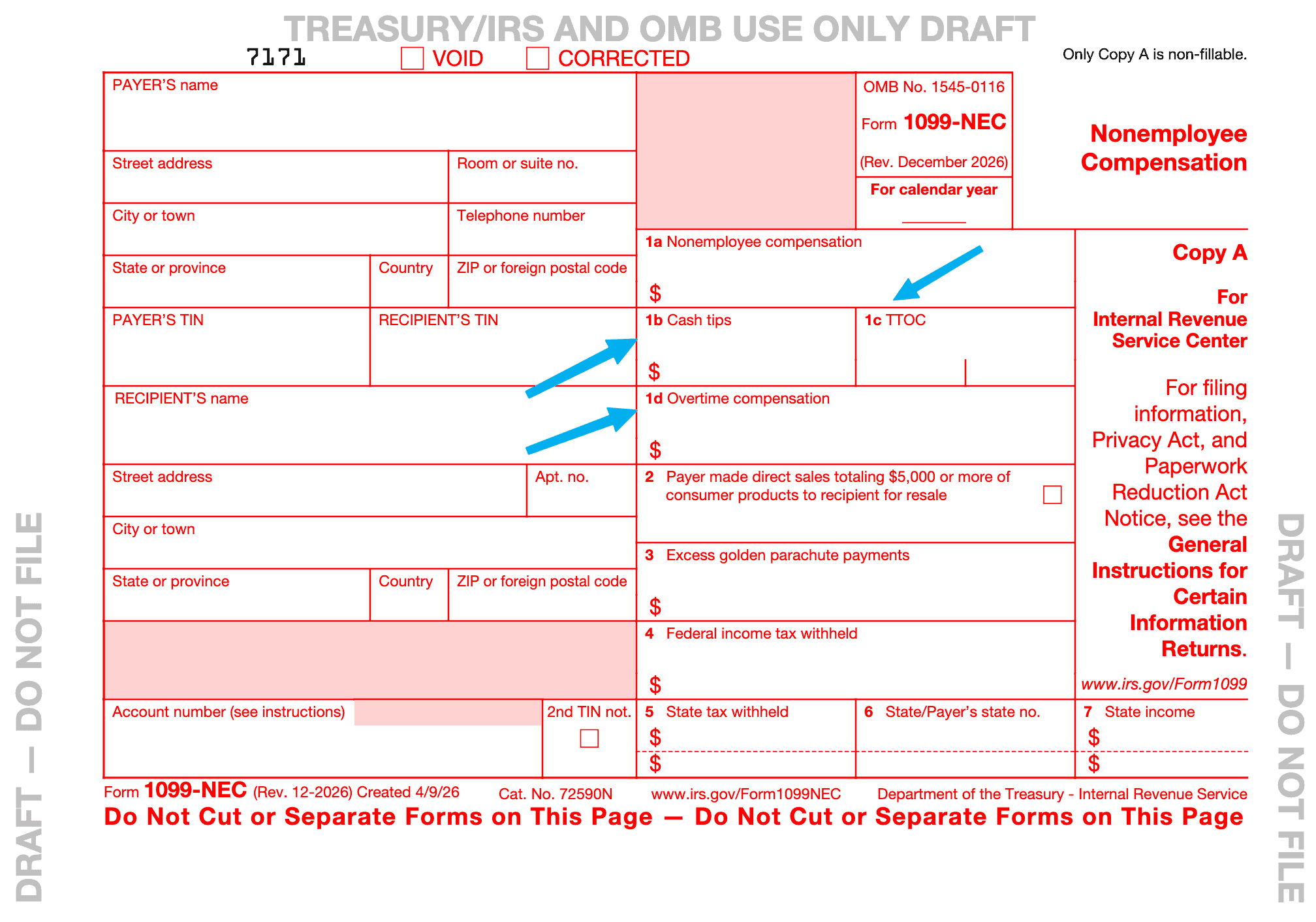
New Box 1b would report cash tips, new Box 1c would report up to two Treasury Tipped Occupation Code(s) (TTOCs), and new Box 1d would report overtime compensation.
Draft 2026 Form 1099-NEC: Note the new boxes in the draft form.
The draft recipient instructions state that Box 1b would show the total amount of cash tips, including tips received in cash or charged, and that the amount would be included in Box 1a. Recipients would use the Box 1b amount in determining the qualified tips deduction in Part II of Schedule 1-A (Form 1040).
The draft instructions further state that Box 1c would show up to two TTOCs for the recipient's tipped occupation(s). Those code(s) would be used in determining the deduction for qualified tips on Part II of Schedule 1-A. If occupation code 000 is used and no other code is reported in Box 1c, the cash tips reported in Box 1b would not be qualified tips and would not be used for the deduction.
For Box 1d, the draft instructions state that the box would show the total amount of overtime compensation included in Box 1a. Recipients would use that amount in determining the qualified overtime compensation deduction in Part III of Schedule 1-A. Separate IRS guidance provides that qualified overtime compensation is overtime compensation required under section 7 of the Fair Labor Standards Act, to the extent it exceeds the regular rate of pay.
The changes are consistent with 2026 Publication 1099, which states that Forms 1099-MISC and 1099-NEC have been updated to allow reporting of cash tips, Treasury Tipped Occupation Code, and overtime compensation.

Issue 14 – Applicable Federal Rates for May 2026, Rev. Rul. 2026-09
REV. RUL. 2026-9 TABLE 1
Applicable Federal Rates (AFR) for May 2026
| |
Period for Compounding |
|
Annual |
Semiannual |
Quarterly |
Monthly |
| Short-term |
| AFR |
3.82% |
3.78% |
3.76% |
3.75% |
| 110% AFR |
4.20% |
4.16% |
4.14% |
4.12% |
| 120% AFR |
4.59% |
4.54% |
4.51% |
4.50% |
| 130% AFR |
4.97% |
4.91% |
4.88% |
4.86% |
| Mid-term |
| AFR |
4.08% |
4.04% |
4.02% |
4.01% |
| 110% AFR |
4.49% |
4.44% |
4.42% |
4.40% |
| 120% AFR |
4.91% |
4.85% |
4.82% |
4.80% |
| 130% AFR |
5.32% |
5.25% |
5.22% |
5.19% |
| 150% AFR |
6.15% |
6.06% |
6.01% |
5.98% |
| 175% AFR |
7.19% |
7.07% |
7.01% |
6.97% |
| Long-term |
| AFR |
4.83% |
4.77% |
4.74% |
4.72% |
| 110% AFR |
5.32% |
5.25% |
5.22% |
5.19% |
| 120% AFR |
5.80% |
5.72% |
5.68% |
5.65% |
| 130% AFR |
6.30% |
6.20% |
6.15% |
6.12% |
REV. RUL. 2026-9 TABLE 2
Adjusted AFR for May 2026
| | Annual | Semiannual | Quarterly | Monthly |
| Short-term adjusted AFR | 2.89% | 2.87% | 2.86% | 2.85% |
| Mid-term adjusted AFR | 3.09% | 3.07% | 3.06% | 3.05% |
| Long-term adjusted AFR | 3.65% | 3.62% | 3.60% | 3.59% |
REV. RUL. 2026-9 TABLE 3
Rates Under Section 382 for May 2026
| Adjusted federal long-term rate for the current month | 3.65% |
| Long-term tax-exempt rate for ownership changes during the current month (the highest of the adjusted federal long-term rates for the current month and the prior two months.) | 3.65% |
REV. RUL. 2026-9 TABLE 4
Appropriate Percentages Under Section 42(b)(1) for May 2026
Note: Under section 42(b)(2), the applicable percentage for non-federally subsidized new buildings placed in service after July 30, 2008, shall not be less than 9%.
| Appropriate percentage for the 70% present value low-income housing credit | 8.04% |
| Appropriate percentage for the 30% present value low-income housing credit | 3.44% |
REV. RUL. 2026-9 TABLE 5
Rate Under Section 7520 for May 2026
More Resources
Blog Page
Tax updates, planning ideas, and continuing education notes.
>
Resource List
Forms, handouts, sign-in sheets, and attendee support files.
>
Schedules
Upcoming Fall, Year-End, webinar, and specialty session dates.
>
Get Registered!
Start individual, webinar, package, or group registration.
>
Group Signups
Review office pricing and register teams of three or more.
>
State Requirements
Check CPA CPE rules and renewal guidance by state.
>
Note: To get your “Join Webinar” link, view a session PDF, replay a previous session, or change upcoming seminar dates, click the “Need Help?” button. Enter your registration email to receive a 6-digit access code and open your account.