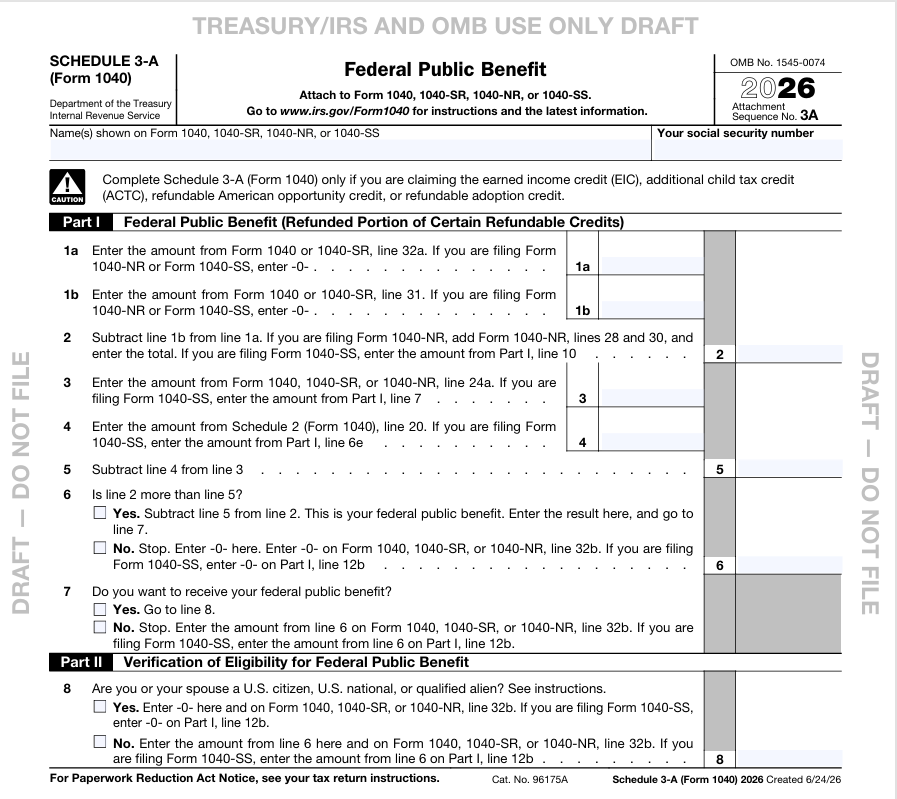
The IRS has released draft Schedule 3-A 📌 (Form 1040), Federal Public Benefit, which introduces an additional eligibility check for taxpayers claiming certain refundable credits.
Schedule 3-A applies when a taxpayer claims the earned income credit (EIC), additional child tax credit (ACTC), refundable American opportunity credit or refundable adoption credit.
Part I calculates whether a portion of these refundable credits is considered a federal public benefit. If the calculation produces a benefit, the taxpayer is asked whether they want to receive it. A taxpayer who answers yes proceeds to Part II, which asks whether the taxpayer or spouse is a U.S. citizen, U.S. national or qualified alien.
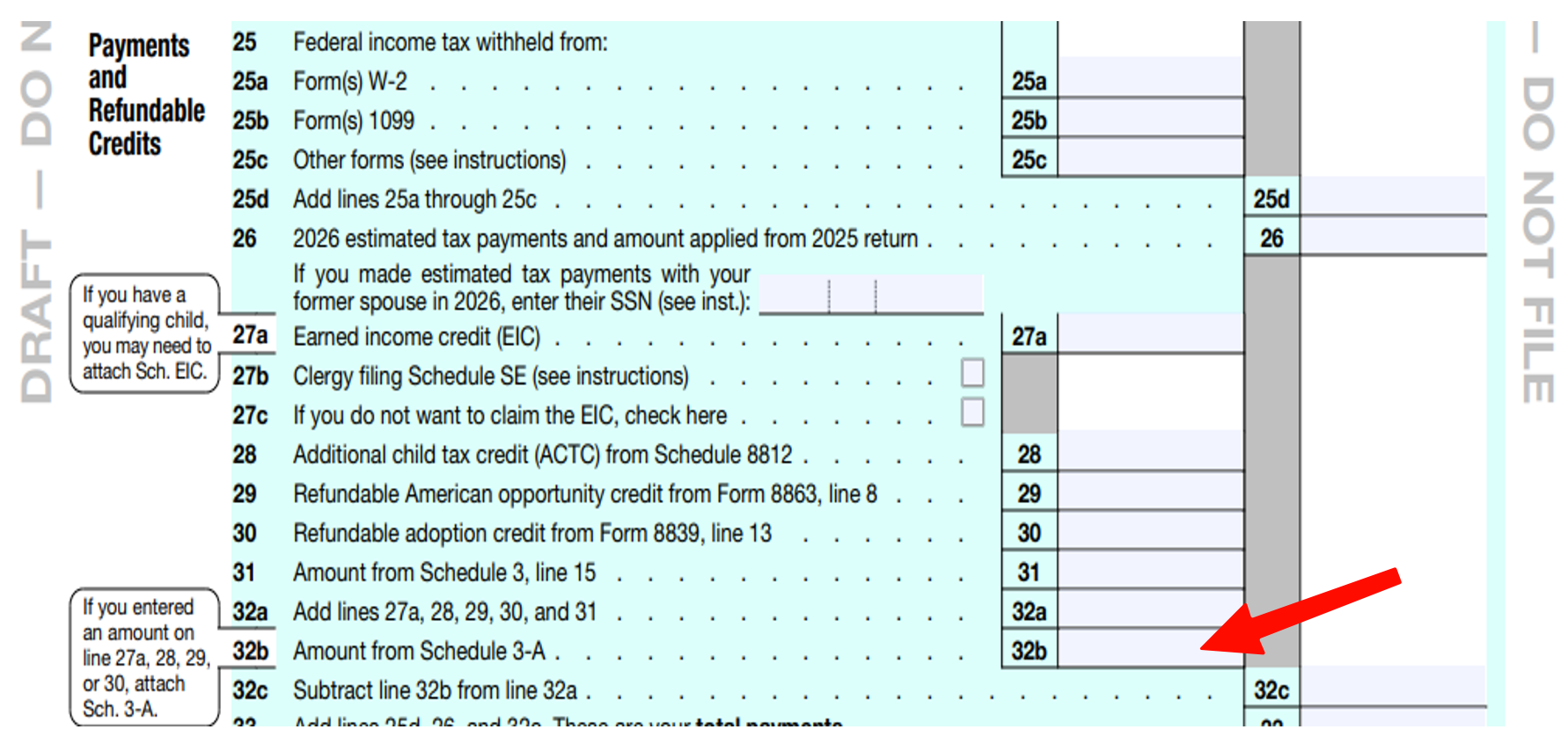
Form 1040, Line 32b, plays an important role in the new process. If the taxpayer chooses not to receive the federal public benefit or does not meet the Part II eligibility requirement, the Schedule 3-A, Line 6, amount is reported on Line 32b. Taxpayers who meet the eligibility requirement enter zero.
Form 1040 Sch 3A Entry Line
Instructions for Form 1040 and Sch 3A have not been issued in draft form.
IRS Schedule 3-A for 2026 is designed for taxpayers claiming specific refundable tax credits, including the earned income credit (EIC) and additional child tax credit (ACTC). This form helps determine eligibility for these credits before they are applied to a taxpayer's refund.
Purpose of IRS Schedule 3-A in 2026
Schedule 3-A serves several important functions for taxpayers.
- Claiming Refundable Credits – Schedule 3-A is specifically for taxpayers claiming refundable credits like the EIC and ACTC.
- Eligibility Checkpoint – It introduces a new checkpoint to verify eligibility for certain tax credits before they are processed.
- Part of Form 1040 – This schedule must be attached to Form 1040 if applicable credits are being claimed.
- Impact on Refunds – The completion of Schedule 3-A can directly affect the amount of refund a taxpayer receives based on their eligibility for credits.
Key Take Aways
The draft directs taxpayers to complete Schedule 3-A only when claiming one or more of these four credits:
- Earned income credit (EIC)
- Additional child tax credit (ACTC)
- Refundable American opportunity credit
- Refundable adoption credit
Schedule 3-A does not determine whether a taxpayer meets the underlying requirements for one of these credits. Instead, it calculates whether a portion of the affected refundable credits is a federal public benefit and determines whether the taxpayer can receive that amount.
How does the new refund checkpoint work?
Part I of draft Schedule 3-A is titled Federal Public Benefit (Refunded Portion of Certain Refundable Credits). It calculates the aggregate refunded portion of the affected refundable credits that is treated as a federal public benefit. The calculation uses amounts from the taxpayer's Form 1040 or other applicable return and Schedule 2. On Line 6, the taxpayer compares the amount calculated on Line 2 with the amount on Line 5.
- If Line 2 is not more than Line 5, there is no federal public benefit. The taxpayer enters zero on Line 6, stops completing Schedule 3-A and enters zero on Form 1040, Line 32b.
- If Line 2 is more than Line 5, the taxpayer subtracts Line 5 from Line 2. The resulting amount is the taxpayer's federal public benefit. That amount is entered on Line 6 and leads to the next checkpoint.
- Line 7 asks whether the taxpayer wants to receive the federal public benefit. A taxpayer who answers no stops and carries the Line 6 amount to Form 1040, Line 32b. A taxpayer who answers yes proceeds to Part II to determine eligibility to receive the benefit.
Eligibility becomes part of the refund analysis
Part II asks whether the taxpayer or spouse is a U.S. citizen, U.S. national or qualified alien. Under the proposed regulations, status is determined on the date the taxpayer files the return that first claims the affected credit, including an early, late or amended return. For a joint return, one spouse's qualifying status is sufficient.
The proposed regulations would also require the taxpayer or one spouse filing jointly to make the applicable declaration under penalty of perjury on the return or schedule prescribed by the IRS. If the answer is yes, the taxpayer enters zero on Schedule 3-A, Line 8, and Form 1040, Line 32b. If the answer is no, the taxpayer enters the federal public benefit from Line 6 on Schedule 3-A, Line 8, and Form 1040, Line 32b.
The proposed regulations identify potential criminal consequences for willfully providing incorrect or untrue information, including a felony under §7206 that may carry a fine of up to $100,000 and imprisonment for up to three years.
For tax professionals, this means qualifying for one of the four underlying credits may not complete the analysis. If the Schedule 3-A calculation produces a federal public benefit and the taxpayer wants to receive it, the return must clear the additional eligibility checkpoint in Part II.
Why Form 1040, Line 32b?
The amount reported on Line 32b represents the federal public benefit calculated on Schedule 3-A that the taxpayer will not receive. There are two primary ways an amount can reach Line 32b under the draft schedule.
First, a taxpayer may have a federal public benefit on Schedule 3-A, Line 6, but answer no when asked whether they want to receive it. In that case, Line 6 amount is carried to Form 1040, Line 32b.
Second, the taxpayer may answer yes to receiving the benefit but answer no to the Part II question asking whether the taxpayer or spouse is a U.S. citizen, U.S. national or qualified alien. In that situation, Line 6 amount is again reported on Form 1040, Line 32b.
Taxpayers who meet the Part II eligibility requirement enter zero on Line 32b.
Client intake and documentation could become critical
The new refund checkpoint may also require tax practices to revisit their client intake and documentation procedures.
Consider a client who qualifies for the American opportunity tax credit. The preparer must still determine qualified education expenses, income limitations and other requirements for claiming the credit.
If the Schedule 3-A calculation produces a federal public benefit, however, the preparer may also need information to accurately answer the eligibility question in Part II.
The same additional review could arise for clients claiming the EIC, ACTC or refundable adoption credit.
Part II presents a yes-or-no question, but determining whether an individual is a U.S. citizen, U.S. national or qualified alien may require additional information. Remember to avoid making assumptions about a client's status based on appearance, country of origin, possession of a Social Security number or treatment on a prior-year return.
Prepare for another layer of refund review
Draft Schedule 3-A signals that preparing certain refundable credits could involve more than determining whether a taxpayer qualifies for the credit itself. Tax pros may also need to calculate whether the credit produces a federal public benefit and determine whether the taxpayer can receive that amount.
Understanding the relationship between Schedule 3-A and Form 1040, Line 32b, will be particularly important. The new line shows how the Schedule 3-A eligibility determination can ultimately affect the client's refund.
The proposed regulations are not final and would apply to tax years ending on or after the date final regulations are published in the Federal Register. Forms and instructions also remain subject to approval, and changes could occur before the 2026 version becomes final.